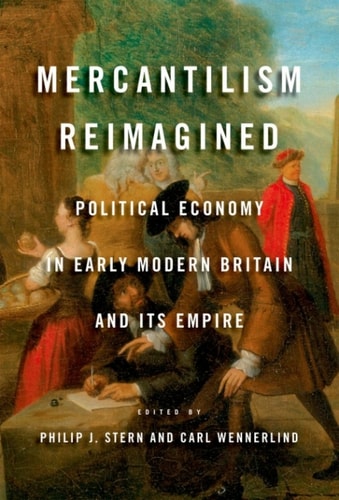
Mercantilism Reimagined: Political Economy in Early Modern Britain and Its Empire
0
0
As an Amazon Associate and affiliate partner, Menrva Books earns from qualifying purchases. Learn more
Author Description
Rethinking Mercantilism brings together a group of young early modern British and European historians to investigate what use the concept "mercantilism" might still hold for both scholars and teachers of the period. While scholars often find the term unsatisfactory, mercantilism has stubbornly survived both in our classrooms and in the general scholarly discourse. These essays propose that it is largely impossible to rethink "mercantilism," given its unique status as a non-entity, by looking for "mercantilism" itself. Economics as a discipline had not emerged by the seventeenth century, yet economic considerations were part of most intellectual pursuits, whether scientific, political, cultural, or social. Thus, the search for "mercantilism" is best undertaken through an investigation of how economic considerations were embedded in debates throughout the early modern intellectual landscape. With this in mind, this book seeks to rethink "mercantilism" inductively rather than deductively. Such an approach not only frees the debate from the strictures and assumptions of historiography reaching back to the Scottish Enlightenment, but also avoids viewing the period through the lens of modern economics. Exploring the period in its own terms makes it possible to revisit fruitfully and more holistically some of the traditional component parts of "mercantilism" such as the relationship between wealth and money, the modern state and commerce, economic and political thought, and power and prosperity only now informed and inflected by the questions raised in new approaches and trends to the intellectual, political, social, and cultural histories that populated the early modern world.The goal of this volume is not to abandon mercantilism as a concept but to rethink its intellectual and political content. First, rather than an ideology driven primarily by self-evident and narrow economic self-interest, "mercantilism" was inseparable from the rich transformations emerging out of th
Menrva's Summary
THE THESIS
This volume investigates whether the concept of "mercantilism" remains a viable analytical tool for understanding the economic and political landscape of early modern Britain and its empire. The editors, Carl Wennerlind and Philip J. Stern, curate a collection of essays that challenge traditional historiographical assumptions by arguing that economic thought in the seventeenth century was not a distinct discipline but was deeply embedded in broader social, political, and cultural intellectual pursuits. By adopting an inductive approach, the contributors aim to move beyond the constraints of modern economic theory to examine how historical actors perceived the relationship between wealth, state power, and commerce in their own terms.
THE SCOPE MAP
What You Will Find
- Analysis of the intellectual history of early modern British economic thought.
- Methodological shift from deductive to inductive historical inquiry.
- Examination of the intersection between state formation and commercial expansion.
- Re-evaluation of traditional components such as the relationship between money, wealth, and political power.
THE AUTHORITY PERSPECTIVE
Scholars and historians recognize this collection as a significant intervention in the historiography of early modern economic thought. Experts highlight the text for its successful attempt to move beyond the limitations of modern economic definitions when analyzing pre-modern political economy.
Page Count:
416
Publication Date:
2013-01-01
Publisher:
Oxford University Press
ISBN-10:
0199988544
ISBN-13:
9780199988549
Economics
History
European History
British History
Special Topics
Great Britain
Economics history
Intellectual History
Modern History
Community Tags
Similar Books




Reader Comments
Share Your Thoughts
No comments yet. Be the first to share your thoughts!