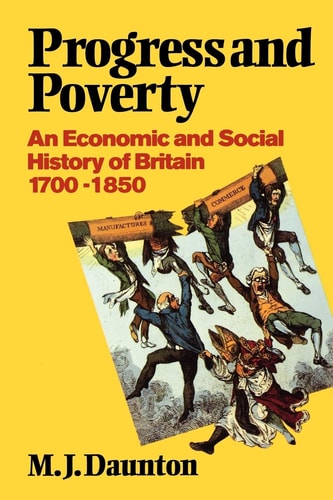
Progress and Poverty: An Economic and Social History of Britain 1700-1850
0
0
As an Amazon Associate and affiliate partner, Menrva Books earns from qualifying purchases. Learn more
Author Description
Previous textbooks on 18th and 19th century Britain have tended to be written either from a social and political standpoint, or about economics in the abstract, as if the history could be reduced to statistical analysis. The aim of this book is to incorporate the revisionist work on British economic growth, which deals impersonally in broad national aggregates, with the work of social and political historians. It stresses the connections between the economy and debates over public policy, and examines the regional variations in agriculture and industry, with particular attention to the differences between England and Scotland. Much revisionist work concerns the operation of assumed national markets; the aim of the book is to show how these markets were formed, and how a national economy was created. The British economy underwent major strucrual change over the period from 1700 to 1850, as population moved from agriculture and rural life to industry and towns.Martin Danton gives a clear and balanced picture of the continuity and change in the early development of the world's first industrial nation. His book will become prescribed reading for all students of 18th and 19th century British history, and for economists studying the industrial revolution.
Menrva's Summary
THE THESIS
This work investigates how the British economy transitioned into the world's first industrial nation between 1700 and 1850 by integrating economic growth data with social and political history. Martin Daunton, a noted historian, challenges the tendency to treat economic history as abstract statistical analysis. He argues that the formation of a national economy was a complex process involving regional variations, public policy debates, and significant structural shifts in population and labor. By synthesizing revisionist economic research with traditional social history, the book provides a comprehensive framework for understanding the development of Britain during this transformative era.
THE SCOPE MAP
What You Will Find
- Analysis of structural changes in the British economy from 1700 to 1850.
- Examination of regional industrial and agricultural variations between England and Scotland.
- Integration of national economic aggregate data with social and political historical contexts.
- Investigation into the formation of national markets and the shift from rural to urban life.
THE AUTHORITY PERSPECTIVE
Experts and students of economic history recognize this text as a balanced synthesis that bridges the gap between quantitative economic analysis and qualitative social history. Readers frequently note the clarity of Daunton's prose, which makes complex structural changes accessible to both historians and economists.
Page Count:
638
Publication Date:
1995-08-24
Publisher:
Oxford University Press
ISBN-10:
0198222815
ISBN-13:
9780198222811
Economics
History
British History
Social History
Great Britain
Community Tags
Similar Books