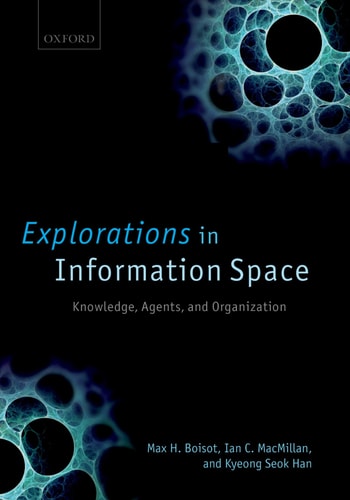
Explorations in Information Space: Knowledge, Agents, and Organization
0
0
As an Amazon Associate and affiliate partner, Menrva Books earns from qualifying purchases. Learn more
Author Description
With the rise of the knowledge economy, the knowledge content of goods and services is going up just as their material content is declining. Economic value is increasingly seen to reside in the former - that is, in intangible assets - rather than in the latter. Yet we keep wanting to turn knowledge back into something tangible, something with definite boundaries which can be measured, manipulated, appropriated, and traded. In short, we want to reify knowledge.Scholars have been debating the nature of knowledge since the time of Plato. Many new insights have been gained from these debates, but little theoretical consensus has been achieved. Through six thematically linked chapters, the book articulates the theoretical approach to the production and distribution of knowledge that underpins Max Boisot's conceptual framework, the Information Space or I-Space. In this way the book looks to provide theoretical and practical underpinnings to Boisot's book Knowledge Assets(OUP, 1998).Following an introductory chapter, how knowledge relates to data and information is first examined in chapter 1, and how different economic actors - entrepreneurs, managers, etc - use knowledge as a basis for action is explored in chapter 2. Chapter 3 looks at how the heterogeneity of economic actors arises naturally from their respective data processing strategies in spite of any similarities in the data that they might share. Chapter 4 argues, contra much transaction-based economics, that an organizational order must have preceded a market order, something that should be reflected in any knowledge-based theory of the firm. Chapter 5 discusses the cultural and institutional significance of different kinds of knowledge flows. Finally, chapter 6 presents an agent-based simulation model, SimISpace, that illustrates how the I-Space might be applied to concrete problems such those of intellectual property rights. A concluding chapter proposes a research agenda based on the theorizing developed in the book.The approach the book sets out is used by a whole range of organizations to issues of knowledge management, policy, economics, and organizational and cultural change.
Menrva's Summary
THE THESIS
This book investigates the theoretical and practical application of the Information Space (I-Space) framework to understand how knowledge functions as an intangible economic asset. The authors, including Max H. Boisot, build upon long-standing philosophical debates regarding the nature of knowledge to provide a structured approach for analyzing its production, distribution, and organizational utility. By moving away from the reification of knowledge as a tangible commodity, the text offers a rigorous conceptual model for how economic actors process data and navigate knowledge flows within institutional frameworks.
THE SCOPE MAP
What You Will Find
- A theoretical analysis of the relationship between data, information, and knowledge.
- An examination of how economic actors utilize distinct data processing strategies to create heterogeneity.
- A critique of traditional transaction-based economics regarding the origins of organizational and market order.
- The introduction of SimISpace, an agent-based simulation model designed to address practical problems like intellectual property rights.
THE AUTHORITY PERSPECTIVE
Experts recognize this work as a critical extension of Boisot's earlier research on knowledge assets, providing a necessary theoretical foundation for scholars of organizational economics. Readers frequently note the academic density of the prose, which is best suited for those already familiar with information theory and institutional economics.
Page Count:
256
Publication Date:
2008-03-15
Publisher:
Oxford University Press
ISBN-10:
0199250871
ISBN-13:
9780199250875
Business
Economics
Information superhighway
Management
Organizational Theory
Special Topics
Intellectual Property
Information Theory
Organizational Learning
Community Tags
Other Editions(2)

Similar Books


Reader Comments
Share Your Thoughts
No comments yet. Be the first to share your thoughts!