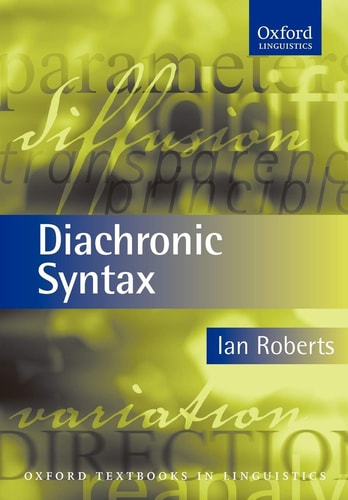
Diachronic Syntax
0
0
As an Amazon Associate and affiliate partner, Menrva Books earns from qualifying purchases. Learn more
Author Description
This is an introduction to syntactic change from the perspective of generative theory. Generative diachronic syntax has developed since the inception of the principles and parameters approach to comparative syntax in the early 1980s and have become increasingly important in historical linguistics and generative theory: it acts as a bridge between them and has provided insights to both. The generative approach was developed to account for synchronic variation: Ian Roberts shows how it may be used to understand how and why languages change. He relates work in historical linguistics to contemporary work on universal grammar and historical syntactic variation. He explains how standard questions in historical linguistics - including word-order change, grammaticalisation, and reanalysis - can be helpfully explored in terms of current generative syntax. He examinbes the nature of the links between syntactic change and first-language acquisition and language learnability and concludes by considering the short and long-term effects of language contact. Professor Roberts illustrates his exposition with numerous examples from a range of different languages and provides guides to further reading and a comprehensive glossary.
Menrva's Summary
THE THESIS
This text investigates the mechanisms of syntactic change through the lens of generative linguistic theory. Ian Roberts, a professor of linguistics, utilizes the principles and parameters framework to bridge the gap between historical linguistics and contemporary generative theory. He argues that the tools developed for synchronic variation provide a robust methodology for explaining the diachronic evolution of language structures.
THE SCOPE MAP
What You Will Find
- Analysis of word order change, grammaticalization, and reanalysis within generative syntax.
- Examination of the relationship between syntactic change and first-language acquisition.
- Discussion on the impact of language contact on long-term linguistic development.
- Comparative examples drawn from a diverse range of global languages.
THE AUTHORITY PERSPECTIVE
Experts recognize this work as a foundational text for students and researchers seeking to apply generative principles to historical data. Readers frequently note the academic density of the prose, which requires a solid background in syntactic theory to fully grasp the arguments presented.
Page Count:
524
Publication Date:
2007-03-01
Publisher:
Oxford University Press, U.S.A.
ISBN-10:
0199253986
ISBN-13:
9780199253982
English & College Success
Historical linguistics
Syntax
English
Academic
Linguistics
Reference