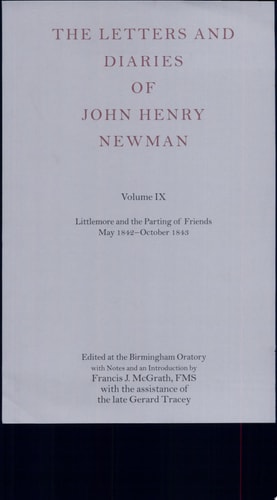
The Letters and Diaries of John Henry Newman: Volume IX: Littlemore and the Parting of Friends May 1842-October 1843
0
0
As an Amazon Associate and affiliate partner, Menrva Books earns from qualifying purchases. Learn more
Author Description
John Henry Newman (1801-90) was brought up in the Church of England in the Evangelical tradition. An Oxford graduate and Fellow of Oriel College, he was appointed Vicar of St Mary's Oxford in 1828; from 1839 onwards he began to have doubts about the claims of the Anglican Church and in 1845 he was received into the Roman Catholic Church. He was made a Cardinal in 1879. His influence on both the restoration of Roman Catholicism in England and the advance of Catholic ideas in the Church of England was profound.This volume covers a crucially important and significant period in Newman's life. The Church of England bishops' continuing condemnation of Tract 90 - plus Pusey's two-year suspension for preaching a university sermon on the Real Presence - are major factors in Newman resigning as Vicar of St Mary's, Oxford. His doubts about the Church of England are deeper and stronger than ever, and he is moving closer to Rome. William Lockhart's sudden defection to Rome in August 1843 precipitates his resignation. He preaches his final Anglican sermon, 'The Parting of Friends', and retires into lay communion at Littlemore. The first edition of University Sermons, including the celebrated sermon on theological development, virtually sells out within a fortnight.
Menrva's Summary
THE THESIS
This volume investigates the critical transition period of John Henry Newman’s life as he navigates the theological and institutional conflicts that led to his departure from the Church of England. Editors Francis J. McGrath and Gerard Tracey compile primary source correspondence and diary entries to document the intellectual and spiritual pressures Newman faced between 1842 and 1843. The text provides a granular view of the ecclesiastical climate, the condemnation of Tract 90, and the personal crises that culminated in his resignation from St. Mary’s, Oxford. By presenting these documents chronologically, the editors establish a framework for understanding the internal logic behind Newman’s eventual conversion to Roman Catholicism.
THE SCOPE MAP
What You Will Find
- Primary source correspondence and personal diary entries from May 1842 to October 1843.
- Detailed documentation regarding the fallout of Tract 90 and the suspension of Edward Bouverie Pusey.
- Contextual analysis of the theological debates surrounding the Real Presence and doctrinal development.
- Insight into the social and professional dynamics of the Oxford Movement and the eventual move to Littlemore.
THE AUTHORITY PERSPECTIVE
Scholars and historians regard this volume as a foundational resource for understanding the internal mechanics of the Oxford Movement. Readers frequently note the academic density of the prose, which serves as an essential reference for those studying 19th-century ecclesiastical history.
Page Count:
880
Publication Date:
2006-05-04
Publisher:
OUP/Birmingham Oratory
ISBN-10:
0199254583
ISBN-13:
9780199254583
Biography
History
Religion
Christianity
Theology
Great Britain
Primary Sources
Catholic Church
Community Tags
Similar Books