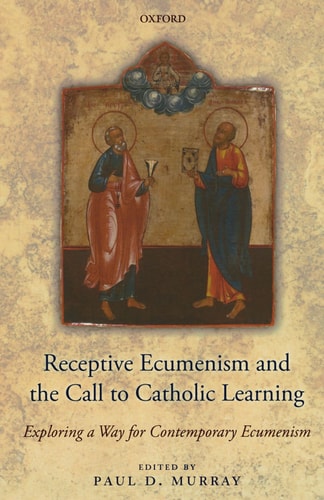
Receptive Ecumenism and the Call to Catholic Learning: Exploring a Way for Contemporary Ecumenism
0
0
As an Amazon Associate and affiliate partner, Menrva Books earns from qualifying purchases. Learn more
Author Description
This volume proposes a fresh strategy for ecumenical engagement - 'Receptive Ecumenism' - that is fitted to the challenges of the contemporary context and has already been internationally recognised as making a distinctive and important new contribution to ecumenical thought and practice. Beyond this, the volume tests and illustrates this proposal by examining what Roman Catholicism in particular might fruitfully learn from its ecumenical others.Challenging the tendency for ecumenical studies to ask, whether explicitly or implicitly, 'What do our others need to learn from us?', this volume presents a radical challenge to see ecumenism move forward into action by highlighting the opposite question 'What can we learn with integrity from our others?'This approach is not simply ecumenism as shared mission, or ecumenism as problem-solving and incremental agreement but ecumenism as a vital long-term programme of individual, communal and structural conversion driven, like the Gospel that inspires it, by the promise of conversion into greater life and flourishing. The aim is for the Christian traditions to become more, not less, than they currently are by learning from, or receiving of, each other's gifts.The 32 original essays that have been written for this unique volume explore these issues from a wide variety of denominational and disciplinary perspectives, drawing together ecclesiologists, professional ecumenists, sociologists, psychologists, and organizational experts.
Menrva's Summary
THE THESIS
This volume investigates how the framework of 'Receptive Ecumenism' can shift the focus of inter-denominational dialogue from teaching others to actively learning from them. Paul Murray, a prominent theologian, curates a collection of essays that challenge traditional ecumenical models by proposing a structural and communal conversion process. The book argues that Christian traditions should seek to receive gifts from one another to foster greater flourishing, rather than focusing solely on incremental agreement or problem-solving.
THE SCOPE MAP
What You Will Find
- A comprehensive exploration of the 'Receptive Ecumenism' methodology across 32 original essays.
- Interdisciplinary perspectives including ecclesiology, sociology, psychology, and organizational theory.
- Critical analysis of the shift from 'What can others learn from us?' to 'What can we learn from others?'
- Case studies and theoretical frameworks for structural and individual conversion within church traditions.
THE AUTHORITY PERSPECTIVE
Experts recognize this collection as a foundational text for modern ecumenical studies, noting its significant impact on both academic discourse and practical church engagement. Readers frequently highlight the academic density of the prose, which effectively bridges the gap between high-level theology and organizational application.
Page Count:
570
Publication Date:
2010-06-18
Publisher:
Oxford University Press
ISBN-10:
0199587981
ISBN-13:
9780199587988
Religion
Christianity
Catholicism
Theology
Ecumenism
Catholic Church
Community Tags
Similar Books