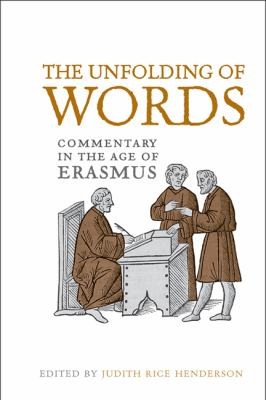
The Unfolding of Words: Commentary in the Age of Erasmus
0
0
As an Amazon Associate and affiliate partner, Menrva Books earns from qualifying purchases. Learn more
Author Description
Leading sixteenth-century scholars such as Martin Luther and Desiderius Erasmus used print technology to engage in dialogue and debate with authoritative contemporary texts. By what Juan Luis Vives termed 'the unfolding of words,' these humanists gave old works new meanings in brief notes and extensive commentaries, full paraphrases, or translations. This critique challenged the Middle Ages' deference to authors and authorship and resulted in some of the most original thought - and most violent controversy - of the Renaissance and Reformation. The Unfolding of Words brings together international scholarship to explore crucial changes in writers' interactions with religious and classical texts. This collection focuses particularly on commentaries by Erasmus, contextualizing his Annotations and Paraphrases on the New Testament against broader currents and works by such contemporaries as François Rabelais and Jodocus Badius. The Unfolding of Words tracks humanist explorations of the possibilities of the page that led to the modern dictionary, encyclopedia, and scholarly edition.
Menrva's Summary
THE THESIS
This book investigates how sixteenth-century scholars, particularly Desiderius Erasmus, utilized print technology to reinterpret classical and religious texts, thereby challenging medieval deference to authorship and fostering original thought and controversy. The collection explores crucial changes in writers' interactions with texts, focusing on Erasmus's commentaries on the New Testament. It contextualizes his work against contemporaries like François Rabelais and Jodocus Badius, tracing how humanist engagement with the printed page led to foundational scholarly tools like the dictionary, encyclopedia, and scholarly edition.
THE SCOPE MAP
- Exploration of 'the unfolding of words' as a method of textual interpretation by Renaissance humanists.
- Analysis of commentaries, paraphrases, and translations by scholars such as Martin Luther and Desiderius Erasmus.
- Focus on Erasmus's Annotations and Paraphrases on the New Testament.
- Contextualization of Erasmus's work within broader currents of the Renaissance and Reformation.
- Examination of interactions with religious and classical texts.
- Discussion of the role of print technology in scholarly dialogue and debate.
- Tracing the development of modern scholarly tools like the dictionary and encyclopedia.
THE AUTHORITY PERSPECTIVE
This collection brings together international scholarship to explore crucial changes in writers' interactions with religious and classical texts during the Renaissance and Reformation. It particularly focuses on commentaries by Erasmus, contextualizing his work against broader currents and contemporaries. The book tracks humanist explorations of the possibilities of the page that led to the modern dictionary, encyclopedia, and scholarly edition. The scholarship presented challenges the Middle Ages' deference to authors and authorship, highlighting the original thought and controversy of the era.
Page Count:
278
Publication Date:
2012-01-01
ISBN-10:
1442643374
ISBN-13:
9781442643376
Non-Fiction
History
Humanism
Reformation
Renaissance
Community Tags
Similar Books