Days Linked by Song: Prudentius' Cathemerinon
0
0
As an Amazon Associate and affiliate partner, Menrva Books earns from qualifying purchases. Learn more
Author Description
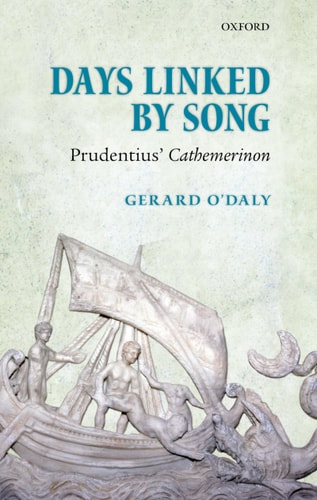
Prudentius is often considered the greatest Latin poet of late antiquity. In this volume, O'Daly looks at Prudentius' lyric poems, the Cathemerinon, Poems for the Day, which were published early in the fifth century AD. Reflecting the religious concerns of the increasingly Christianized western Roman Empire in the age of the emperor Theodosius and Ambrose of Milan, the Cathemerinon are above all the writings of a private person, and of the ways in which his religious beliefs colour his everyday life. They speak of bird-song and morning light, they are about about the taking of food, about lighting lamps as dark sets in, and about the night's sleep. Rich in biblical themes and earratives, images and symbols (including paradise and the Fall, Exodus, Jonah, Daniel, and the Magi), they also celebrate Christ's miracles and the feasts of Christmas and Epiphany.However, while they exploit the themes of the Bible, they are also written in the classical metres of Latin poetry and make use of its vocabulary and metaphors. They achieve a remarkable creative tension between the two worlds that determined Prudentius' culture: the beliefs and practices, sacred books, and doctrines of Christianity; and the traditions, poetry, and ideas of the Greeks and Romans. A good part of the attractiveness of these poems comes from the interplay between these two worlds.The volume includes the Latin texts, English translations, and critical essays on each of the twelve poems.
Menrva's Summary
THE THESIS
This volume investigates how the fifth-century poet Prudentius synthesized classical Latin literary traditions with the emerging religious doctrines of a Christianized Roman Empire. Gerard O'Daly, a scholar of classical literature, examines the Cathemerinon to demonstrate how Prudentius navigated the creative tension between pagan poetic forms and biblical narratives. By analyzing the intersection of daily life and sacred belief, the author argues that these poems serve as a primary record of the cultural transition occurring during the age of Theodosius and Ambrose of Milan.
THE SCOPE MAP
What You Will Find
- A comprehensive analysis of the twelve poems comprising the Cathemerinon.
- Comparative study of classical Latin meters and biblical imagery.
- Parallel presentation of original Latin texts alongside English translations.
- Critical essays detailing the historical and theological context of late antiquity.
THE AUTHORITY PERSPECTIVE
Scholars recognize this work as a vital resource for understanding the linguistic and thematic fusion of late antique poetry. Readers frequently note that the inclusion of both the original Latin and critical commentary makes this an accessible yet rigorous text for students of classical and religious history.
Page Count:
536
Publication Date:
2012-07-13
Publisher:
Oxford University Press
ISBN-10:
0199263957
ISBN-13:
9780199263950
Poetry
History
Latin poetry
Latin
Criticism history
Literary Criticism
Christianity
Community Tags
Similar Books