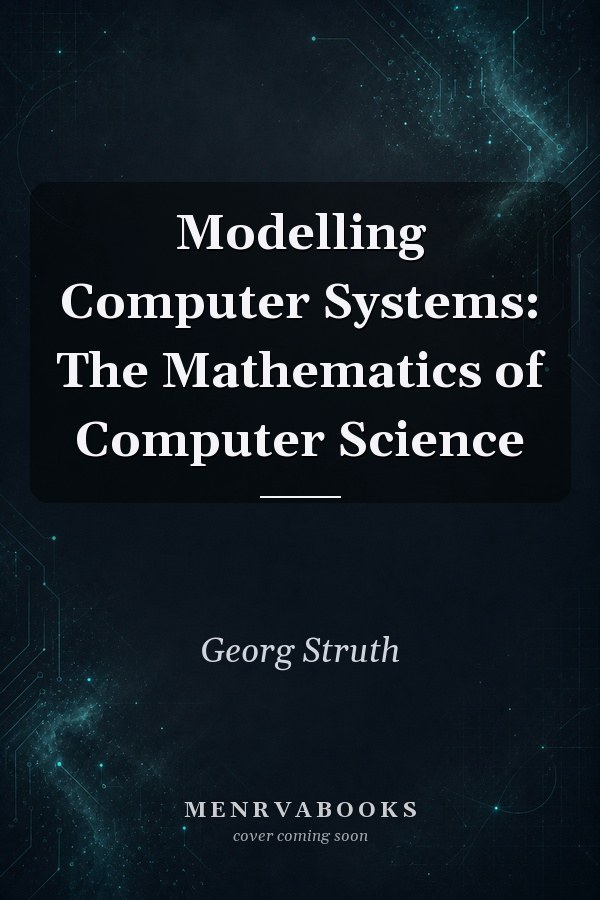
Modelling Computer Systems: The Mathematics of Computer Science
0
0
As an Amazon Associate and affiliate partner, Menrva Books earns from qualifying purchases. Learn more
Author Description
We have all experienced delays and frustrations as a result of the notorious ‘computer glitch.’ However, the more dependent we become on computational systems in our daily lives, the more we must ensure that they are safe, reliable and user-friendly. This engaging textbook presents the fundamental mathematics and modelling techniques for computing systems in a novel and light-hearted way, which can be easily followed by students at the very beginning of their university education. Key concepts are taught through a large collection of challenging yet fun mathematical games and logical puzzles that require no prior knowledge about computers. The text begins with intuition and examples as a basis from which precise concepts are then developed; demonstrating how, by working within the confines of a precise structured method, the occurrence of errors in the system can be drastically reduced. Topics and features: Introduces important concepts from discrete mathematics as the basis of computational thinking, presented in a stimulating and motivating style Demonstrates how game theory provides a paradigm for an intuitive understanding of the nature of computation Contains more than 400 exercises throughout the text, with detailed solutions to half of these presented at the end of the book, together with numerous theorems, definitions and examples Describes an approach to the modelling of computing systems based on state transition systems, exploring the languages and techniques for expressing and reasoning about systems specifications and concurrent implementations This clearly written and classroom-tested textbook/reference is essential reading for first-year undergraduate modules on discrete mathematics and systems modelling.
Menrva's Summary
THE THESIS
This textbook investigates the fundamental mathematics and modelling techniques essential for ensuring the safety, reliability, and user-friendliness of computational systems. Georg Struth, an educator with experience in university-level discrete mathematics and systems modelling, presents these concepts through a collection of mathematical games and logical puzzles, requiring no prior computer knowledge. The book builds intuition and precise concepts by demonstrating how structured methods can drastically reduce system errors, exploring topics such as discrete mathematics for computational thinking, game theory for understanding computation, and state transition systems for modelling and reasoning about system specifications and concurrent implementations.
THE SCOPE MAP
- Introduces key concepts from discrete mathematics as the foundation for computational thinking.
- Utilizes game theory to provide an intuitive understanding of the nature of computation.
- Features over 400 exercises, with detailed solutions provided for half of them.
- Explores state transition systems as an approach to modelling computing systems.
- Covers languages and techniques for expressing and reasoning about system specifications.
- Discusses methods for concurrent implementations.
- Includes numerous theorems, definitions, and examples throughout the text.
THE AUTHORITY PERSPECTIVE
This textbook is designed as essential reading for first-year undergraduate modules on discrete mathematics and systems modelling. The approach is noted for its stimulating and motivating style, employing mathematical games and logical puzzles to teach core concepts. Its classroom-tested nature suggests a pedagogical focus aimed at making complex topics accessible to students at the beginning of their university education. The inclusion of a large number of exercises with solutions further supports its utility as a learning resource.
Page Count:
500
Publication Date:
2012-01-01
ISBN-10:
1848003218
ISBN-13:
9781848003217
Science & Technology
Science
Non-Fiction
Computer Science
Discrete Mathematics
Game theory
Logic puzzles
Community Tags
Similar Books