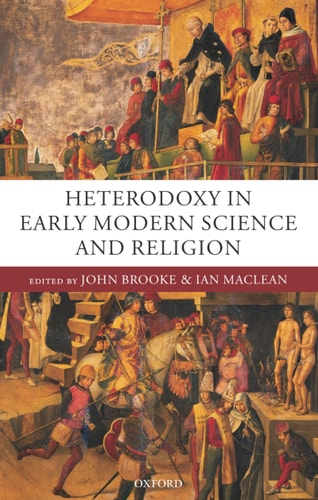
Heterodoxy in Early Modern Science and Religion
0
0
As an Amazon Associate and affiliate partner, Menrva Books earns from qualifying purchases. Learn more
Author Description
The separation of science and religion in modern secular culture can easily obscure the fact that in sixteenth- and seventeenth-century Europe ideas about nature were intimately related to ideas about God. Readers of this book will find fresh and exciting accounts of a phenomenon common to both science and religion: deviation from orthodox belief. How is heterodoxy to be measured? How might the scientific heterodoxy of particular thinkers impinge on their religious views? Would heterodoxy in religion create a predisposition towards heterodoxy in science? Might there be a homology between heterodox views in both domains? Such major protagonists as Galileo and Newton are re-examined together with less familiar figures in order to bring out the extraordinary richness of scientific and religious thought in the pre-modern world.
Menrva's Summary
THE THESIS
This work investigates the complex, often overlapping relationship between scientific inquiry and religious belief in sixteenth- and seventeenth-century Europe, specifically focusing on the concept of heterodoxy. Authors Ian Maclean and John Brooke utilize historical analysis to challenge the modern assumption that science and religion have always been distinct, separate spheres. By examining the intellectual lives of figures ranging from Galileo and Newton to lesser-known thinkers, the authors argue that deviations from orthodoxy in one domain frequently informed or mirrored deviations in the other.
THE SCOPE MAP
What You Will Find
- Analysis of the intellectual climate in sixteenth
- and seventeenth-century Europe.
- Examination of the relationship between scientific innovation and theological non-conformity.
- Comparative studies of major figures like Galileo and Newton alongside obscure historical thinkers.
- Methodological frameworks for measuring and defining heterodoxy within pre-modern contexts.
THE AUTHORITY PERSPECTIVE
Scholars and historians of science frequently cite this text as a nuanced contribution to the study of early modern intellectual history. Readers often note the academic density of the prose, which provides a rigorous examination of the interplay between natural philosophy and religious doctrine.
Page Count:
406
Publication Date:
2006-01-19
Publisher:
Oxford University Press
ISBN-10:
0199268975
ISBN-13:
9780199268979
Philosophy
Science
Religion
History
Science
Heresy
Intellectual History
Community Tags
Similar Books