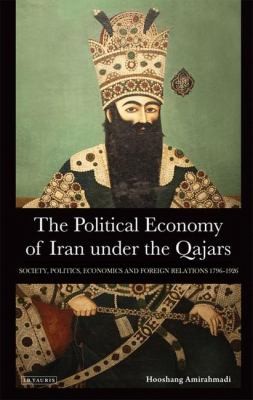
The Political Economy of Iran Under the Qajars: Society, Politics, and Foreign Relations, 1796-1926
0
0
As an Amazon Associate and affiliate partner, Menrva Books earns from qualifying purchases. Learn more
Author Description
The creation of the Egyptian monarchy in 1922, under King Fuad II, opened contests and debates over fundamental cultural questions, particularly definitions of Egyptian modernity, rule and identity. Here, James Whidden looks at the political, cultural and intellectual landscapes of Egypt between the wars, from the nationalist agitations for independence in 1919, the rise of the Wafd - first under Saad Zaghul and then Mustafa El-Nahas Pasha - and the rise and fall of different political and power brokers in the period such as Abd al-Latif al-Makkabati or Abd al-Khaliq Tharwa. Whidden therefore focuses on the different interpretations of the nature of Egyptian politics, highlighting the ways in which patriotism and elitism, Islam and tradition, colonial manipulations, and ideological politics combine. In particular, he examines how monarchists, like Zaki Fahmi and Diaeddine Saleh, attempted to neutralise opponents through cultural works, patronage and political party contests. The period under examination was to a large extent defined by the 'revolution' of 1919 and the constitutional and electoral processes that followed. The sectors of society involved in this were the effendiyya and the notables - such as Zaghul. But these were soon dominated by the monarch, as the Wafd party allied with the king. Bearing this in mind, Whidden examines how these notables attempts to mobilise the people in revolutionary activity, electoral contest and the formation of political party organization in this period. Although a 'liberal constitution' was written by an appointed constitutional commission in 1923, Whidden argues that the disagreements it occasioned suggest that politics in the interwar period was very much an attempt to redefine or rewrite that constitution to the differing assumptions of liberal, nationalists and monarchists. Monarchy and Modernity in Egypt is thus a vital resource for those interested in Middle East history, as well as intellectual developments within t
Menrva's Summary
THE THESIS
This book examines the complex interplay of internal political structures, economic development, and foreign relations in Iran during the Qajar dynasty. It investigates the period from the dynasty's establishment in 1796 through its dissolution in 1926, a time marked by significant challenges to Iranian sovereignty and modernization efforts. The work analyzes how domestic power struggles, the influence of European imperial powers, and evolving economic policies shaped Iran's trajectory.
THE SCOPE MAP
- Analysis of the Qajar dynasty's political institutions and their evolution.
- Examination of economic policies, including trade, taxation, and resource management.
- Detailed study of foreign relations, particularly interactions with Russia and Great Britain.
- Exploration of social dynamics and the impact of modernization on Iranian society.
- Discussion of the factors leading to the Qajar dynasty's decline and eventual fall.
THE AUTHORITY PERSPECTIVE
The book offers a comprehensive historical analysis of Iran under the Qajars, focusing on the critical period between 1796 and 1926. It delves into the intricate connections between the nation's political economy, its internal social structures, and its engagement with global powers. The work is likely to be of interest to scholars and students of Middle Eastern history, political science, and economic history, providing a detailed account of a pivotal era in Iran's development.
Page Count:
319
Publication Date:
2012-01-01
ISBN-10:
1848856725
ISBN-13:
9781848856721
Economics
Non-Fiction
History
Politics
Community Tags
Similar Books