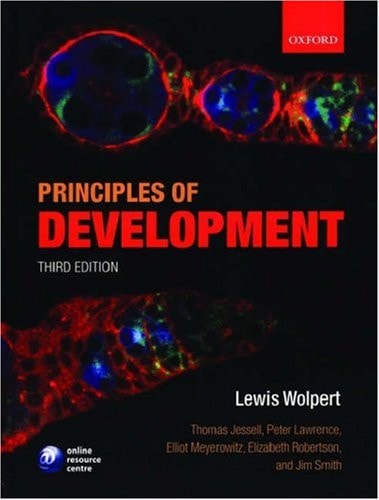
Principles of Development
0
0
As an Amazon Associate and affiliate partner, Menrva Books earns from qualifying purchases. Learn more
Author Description
Developmental biology is at the core of all biology. It deals with the processes by which the genes in the fertilized egg control cell behavior in the embryo and so determine its pattern, its form, and much of its behavior. The progress in developmental biology in recent years, with the applications of advances in cell and molecular biology, has been remarkable, and an enormous amount of information is now available. Designed for undergraduates, Principles of Development emphasizes basic principles and key concepts in developmental biology. Central to the authors' approach is the idea that development can best be understood by analyzing how genes control cell behavior. They have assumed that students have some basic familiarity with cell biology and genetics, but all key concepts, like the control of gene activity, are explained in the text. The authors have resisted the temptation to cover every aspect of development and have instead focused on those systems that best illuminate common principles, demonstrating throughout the book that there are universal principles governing development. The focus of the text is on vertebrates and Drosophila, but not to the exclusion of other systems, such as the nematode and the sea urchin, where they best illustrate a concept. An important feature of the book is the inclusion of the development of plants, a topic that has some unique and significant attributes but one that is usually neglected in other texts. Principles are presented clearly and numerous summaries are provided, both in words and in pictures. The illustrations in the book have been carefully designed and chosen to illustrate both experiments and mechanisms.
Menrva's Summary
THE THESIS
This text investigates the fundamental biological processes by which genetic information within a fertilized egg dictates the complex patterns, forms, and behaviors of an developing embryo. The authors, a team of distinguished biologists including Lewis Wolpert, utilize a framework centered on the molecular control of cell behavior to explain how universal principles govern development across diverse organisms. By assuming a foundational knowledge of cell biology, the text synthesizes recent advancements in molecular research into a coherent pedagogical structure for undergraduate students.
THE SCOPE MAP
What You Will Find
- Analysis of gene activity and its role in regulating cellular differentiation and morphogenesis.
- Comparative study of developmental systems including vertebrates, Drosophila, nematodes, and sea urchins.
- Integration of plant development to provide a comprehensive view of biological growth patterns.
- Extensive use of visual diagrams and experimental summaries to clarify complex mechanical processes.
THE AUTHORITY PERSPECTIVE
Experts and educators frequently cite this work as a foundational textbook for undergraduate developmental biology courses due to its focus on universal mechanisms rather than exhaustive cataloging. Readers often note the clarity of the illustrations and the logical progression of concepts, which effectively bridge the gap between basic genetics and complex embryological development.
Page Count:
576
Publication Date:
2006-08-01
Publisher:
Oxford University Press, Incorporated
ISBN-10:
019927536X
ISBN-13:
9780199275366
Science
Developmental Biology
Biology
Genetics
Textbooks
Community Tags
Similar Books