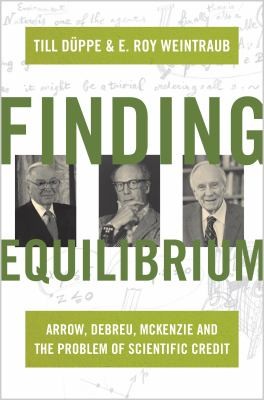
Finding Equilibrium
0
0
As an Amazon Associate and affiliate partner, Menrva Books earns from qualifying purchases. Learn more
Author Description
Finding Equilibrium explores the post-World War II transformation of economics by constructing a history of the proof of its central dogma--that a competitive market economy may possess a set of equilibrium prices. The model economy for which the theorem could be proved was mapped out in 1954 by Kenneth Arrow and Gerard Debreu collaboratively, and by Lionel McKenzie separately, and would become widely known as the "Arrow-Debreu Model." While Arrow and Debreu would later go on to win separate Nobel prizes in economics, McKenzie would never receive it. Till Düppe and E. Roy Weintraub explore the lives and work of these economists and the issues of scientific credit against the extraordinary backdrop of overlapping research communities and an economics discipline that was shifting dramatically to mathematical modes of expression.Based on recently opened archives, Finding Equilibrium shows the complex interplay between each man's personal life and work, and examines compelling ideas about scientific credit, publication, regard for different research institutions, and the awarding of Nobel prizes. Instead of asking whether recognition was rightly or wrongly given, and who were the heroes or villains, the book considers attitudes toward intellectual credit and strategies to gain it vis-à-vis the communities that grant it.Telling the story behind the proof of the central theorem in economics, Finding Equilibrium sheds light on the changing nature of the scientific community and the critical connections between the personal and public rewards of scientific work
Menrva's Summary
THE THESIS
This book investigates the historical development and proof of the central dogma of economics: the existence of equilibrium prices in a competitive market economy. It delves into the lives and work of economists Kenneth Arrow, Gerard Debreu, and Lionel McKenzie, focusing on the collaborative and individual efforts that led to the Arrow-Debreu Model in 1954. The narrative explores the complex interplay between their personal lives and professional achievements, examining issues of scientific credit, publication strategies, and the awarding of Nobel prizes within the shifting landscape of economics.
THE SCOPE MAP
- The historical construction of the proof for the existence of equilibrium prices in competitive market economies.
- Biographical and professional details of economists Kenneth Arrow, Gerard Debreu, and Lionel McKenzie.
- Analysis of the Arrow-Debreu Model, a foundational concept in general equilibrium theory.
- Exploration of scientific credit, intellectual property, and recognition within academic communities.
- Discussion of the awarding of Nobel prizes and the criteria for scientific regard.
- Insights into the transition of economics towards mathematical expression and formal proof.
- Examination of the relationship between personal lives and professional work in scientific endeavors.
THE AUTHORITY PERSPECTIVE
The book is recognized for its detailed exploration of a pivotal moment in economic theory and the lives of the economists involved. It is noted for its use of recently opened archives to shed light on the personal and professional dynamics that shaped the development of the Arrow-Debreu Model. The work is appreciated for its nuanced approach to scientific credit, moving beyond simple judgments of who deserved recognition to analyze the systems and communities that grant it. It offers a compelling look at the changing nature of the scientific community and the intrinsic links between personal and public rewards in academic pursuits.
Page Count:
276
Publication Date:
2014-01-01
ISBN-10:
0691156646
ISBN-13:
9780691156644
Business
History
Economics
Biography
Non-Fiction
Community Tags
Similar Books