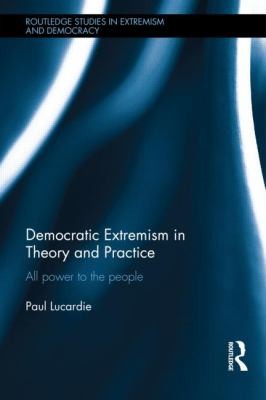
Democratic Extremism
0
0
As an Amazon Associate and affiliate partner, Menrva Books earns from qualifying purchases. Learn more
Author Description
Democracy and extremism are usually considered opposites. We assume our system (in the UK, the USA, The Netherlands etc.) is democratic and extremists try to destroy our system and introduce some kind of dictatorship, if not chaos and anarchy. Yet in many cases, the extremists seem sincere in their attempt to construct a more democratic polity. Hence, they can be called democrats and yet also extremists, in so far as they strive for a regime with characteristics that are more extreme in a significant sense.This book analyses radical and extreme democratic theories and ideas in their historical context, interlocked with a critical description of historical institutions and experiments that help to evaluate the theories. Cases vary from ancient Athens to recent experiments with citizen juries and citizen assemblies, from the time-honoured Swiss Landsgemeinde to contemporary (and controversial) workers councils in Venezuela and participatory budgeting in Porto Alegre. Among the theorists discussed here are familiar names as well as relatively unknown persons: Jean-Jacques Rousseau and Karl Marx, Murray Bookchin and John Burnheim, William Godwin and Barbara Goodwin, Anton Pannekoek and Heinz Dieterich. Whereas the extreme ideas do not seem to work very well in practice, they do indicate ways we could make existing political systems more democratic.This book will be of interest to students of Politics and Current Affairs as well as inspiration for political activists and reformists
Menrva's Summary
THE THESIS
This book investigates the paradoxical concept of democratic extremism, exploring theories and historical instances where radical democratic ideals have manifested. It examines how individuals and movements, often perceived as extremists aiming to dismantle existing systems, may sincerely believe they are striving for a more genuinely democratic society. The analysis spans historical contexts from ancient Athens to contemporary experiments like citizen assemblies and participatory budgeting, evaluating theoretical frameworks alongside practical applications.
THE SCOPE MAP
- Analysis of radical and extreme democratic theories and ideas.
- Examination of historical institutions and experiments related to democracy.
- Case studies including ancient Athens, Swiss Landsgemeinde, citizen juries, citizen assemblies, workers councils in Venezuela, and participatory budgeting in Porto Alegre.
- Discussion of theorists such as Jean-Jacques Rousseau, Karl Marx, Murray Bookchin, John Burnheim, William Godwin, Barbara Goodwin, Anton Pannekoek, and Heinz Dieterich.
- Evaluation of the practical effectiveness of extreme democratic ideas.
- Exploration of how extreme democratic concepts can inform improvements to existing political systems.
THE AUTHORITY PERSPECTIVE
This book offers a nuanced perspective on the relationship between democracy and extremism, challenging conventional oppositions. It is likely to appeal to students of politics and current affairs, as well as those interested in political activism and reform. The work's strength lies in its interdisciplinary approach, blending theoretical analysis with historical case studies. By examining both radical ideas and their practical implementation, the book provides insights into potential pathways for enhancing democratic governance.
Page Count:
194
Publication Date:
2013-01-01
ISBN-10:
0415603129
ISBN-13:
9780415603126
Science
Politics
Non-Fiction
History
Democracy
Political Theory
Extremism
Community Tags
Similar Books