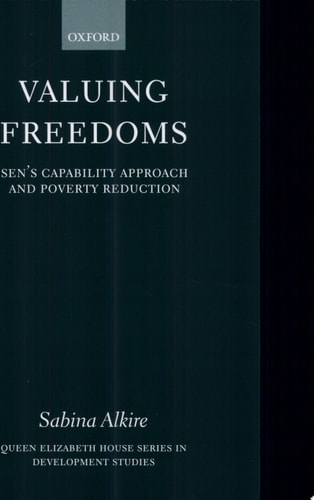
Valuing Freedoms: Sen's Capability Approach and Poverty Reduction
0
0
As an Amazon Associate and affiliate partner, Menrva Books earns from qualifying purchases. Learn more
Author Description
Sabina Alkire shows how Nobel Prize-winning economist Amartya Sen's capability approach can be coherently--and practically--put to work in poverty reduction activities. Sen argues that economic development should expand "valuable" freedoms. Alkire probes how we identify what is valuable. Foundational issues are addressed critically--dimensions of development, practical reason, culture, basic needs--drawing on Thomist authors who give central place to authentic participation. A participatory procedure for identifying capability change is then developed. Case studies of three Oxfam activities in Pakistan--goat-rearing, female literacy, and rose cultivation--illustrate this novel approach.
Menrva's Summary
THE THESIS
This work investigates how Amartya Sen's capability approach can be operationalized to effectively guide poverty reduction initiatives. Sabina Alkire, a scholar in development economics, bridges the gap between abstract economic theory and practical application. By integrating philosophical inquiry with development practice, she proposes a participatory framework for identifying the specific freedoms that communities value most. The text argues that development must be measured by the expansion of these capabilities rather than solely by traditional economic indicators.
THE SCOPE MAP
What You Will Find
- A theoretical framework for identifying 'valuable' freedoms in development contexts.
- A participatory methodology for assessing capability change at the local level.
- Case studies of Oxfam poverty reduction projects in Pakistan, including goat-rearing and female literacy programs.
- An analysis of the intersection between Thomist philosophy and modern development economics.
THE AUTHORITY PERSPECTIVE
Experts recognize this text as a significant contribution to the practical implementation of the capability approach in international development. Readers frequently note the academic density of the prose, which balances rigorous philosophical inquiry with concrete field-based evidence.
Page Count:
350
Publication Date:
2005-05-12
Publisher:
Oxford University Press
ISBN-10:
0199283311
ISBN-13:
9780199283316
Philosophy
Economics
Social policy
Poverty
Community Tags
Other Editions(3)
Similar Books