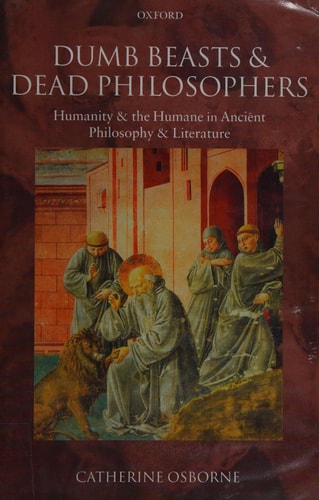
Dumb Beasts and Dead Philosophers: Humanity and the Humane in Ancient Philosophy and Literature
0
0
As an Amazon Associate and affiliate partner, Menrva Books earns from qualifying purchases. Learn more
Author Description
Animal rights do not feature explicitly in ancient thought. Indeed the notion of natural rights in general is not obviously present in the classical world. Plato and Aristotle are typically read as racist and elitist thinkers who barely recognise the humanity of their fellow humans. Surely they would be the last to show up as models of the humane view of other kinds?In this unusual philosophy book, Catherine Osborne asks the reader to think again. She shows that Plato's views on reincarnation and Aristotle's views on the souls of plants and animals reveal a continuous thread of life in which humans are not morally superior to beasts; Greek tragedy turns up thoughts that mirror the claims of rights activists when they speak for the voiceless; the Desert Fathers teach us to admire the natural perceptiveness of animals rather than the corrupt ways of urban man; the long tradition of arguments for vegetarianism in antiquity highlights how mankind's abuse of other animals is the more offensive the more it is for indulgent ends.What, then, is the humane attitude, and why is it better? How does the humane differ from the sentimental? Is there a truth about how we should treat animals? By reflecting on the work of the ancient poets and philosophers, Osborne argues, we can see when and how we lost touch with the natural intelligence of dumb animals.
Menrva's Summary
THE THESIS
This book investigates whether ancient philosophical and literary traditions contain latent, humane attitudes toward animals that challenge modern perceptions of classical elitism. Catherine Osborne, a scholar of ancient philosophy, examines the works of Plato, Aristotle, and the Desert Fathers to uncover a historical continuity regarding the moral status of non-human life. By analyzing these texts, she argues that antiquity offers a sophisticated framework for understanding the natural intelligence of animals and the ethical implications of human behavior toward them.
THE SCOPE MAP
What You Will Find
- Analysis of reincarnation theories in Platonic thought and the classification of souls in Aristotelian biology.
- Examination of Greek tragedy as a medium for articulating the rights of the voiceless.
- Historical survey of vegetarianism and its ethical justifications within ancient philosophical schools.
- Comparative study of urban human corruption versus the natural perceptiveness of animals as depicted by the Desert Fathers.
THE AUTHORITY PERSPECTIVE
Scholars and readers frequently note the book's ability to reframe well-known classical texts through a contemporary ethical lens. Experts highlight this as a provocative contribution to the history of animal ethics that challenges standard interpretations of ancient moral hierarchies.
Page Count:
276
Publication Date:
2007-03-29
Publisher:
Clarendon Press
ISBN-10:
0199282064
ISBN-13:
9780199282067
Philosophy
Humanity
Ethics
Ancient History
Animal Rights
Animal Welfare
Community Tags
Similar Books