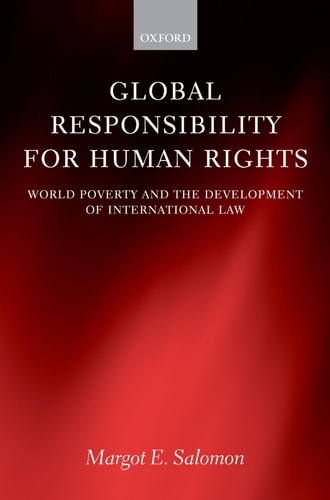
Global Responsibility for Human Rights
0
0
As an Amazon Associate and affiliate partner, Menrva Books earns from qualifying purchases. Learn more
Author Description
World poverty represents a failure of the international community to see half of the global population secure their basic socio-economic rights. Yet international law foresees cooperation as essential to the realization of these human rights. In an era of considerable interdependence and entrenched economic and political advantage, the particular features of contemporary world poverty give rise to pressing questions about the scope, evolution, and application of the international law of human rights, and the attribution of global responsibility.This book considers the evolving nature of public international law and human rights with respect to international cooperation as a basis for addressing the role and responsibility of the international community in the creation of an environment conducive to a human-centered globalization. It offers a detailed examination of the historically controversial right to development and, through a careful consideration of its current significance and application, reflects the importance of the rationale of the right to development onto the critical challenge of poverty in the 21st century. Through doctrine and jurisprudence, this book charts recent changes in international law relevant to the ability of states to develop and to fulfill their human rights obligations, and the reality that they are constrained by the actions and structural arrangements of the powerful members of the international community.This book explores developments in the system of international safeguards meant to correspond to the deprivation of economic, social, and cultural rights today. By analyzing the approach, contribution, and current limitations of the international law of human rights to the manifestations of world poverty, the reader is challenged to rethink human rights and, in particular, the framing of responsibilities that are essential to their protection.
Menrva's Summary
THE THESIS
This book investigates the failure of the international community to secure basic socio-economic rights for the global population and questions how international law can be applied to address world poverty. Margot E. Salomon, with a foreword by Stephen P. Marks, examines the intersection of public international law, human rights, and global economic structures. The author argues that current international legal frameworks must evolve to address the systemic constraints placed on developing states by more powerful international actors. By analyzing doctrine and jurisprudence, the text provides a framework for understanding global responsibility in the context of human-centered globalization.
THE SCOPE MAP
What You Will Find
- An analysis of the evolving nature of public international law regarding international cooperation.
- A detailed examination of the right to development and its application to 21st-century poverty.
- A review of international safeguards designed to protect economic, social, and cultural rights.
- An exploration of how structural arrangements of powerful nations constrain the human rights obligations of other states.
THE AUTHORITY PERSPECTIVE
Experts and legal scholars recognize this work as a significant contribution to the discourse on international human rights law and global economic justice. Readers frequently note the academic density of the prose, which is intended for students and practitioners of international law and political science.
Page Count:
250
Publication Date:
2008-01-10
Publisher:
Oxford University Press
ISBN-10:
0199284423
ISBN-13:
9780199284429
Economics
Human rights
Sociology
International Law
Globalization
Community Tags
Similar Books