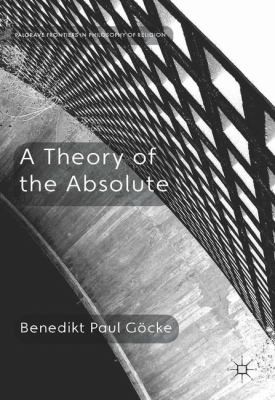
A Theory of the Absolute
0
0
As an Amazon Associate and affiliate partner, Menrva Books earns from qualifying purchases. Learn more
Author Description
The purpose of A Theory of the Absolute is to sketch a theory of the basic structure of empirical reality, and its relation to the Absolute. It is influenced by the methods of analytic philosophy as well as phenomenology. Influential figures are Thomas Aquinas, Meister Eckhart, Karl Christian Friedrich Krause, Edmund Husserl, and Rene Descartes. A Theory of the Absolute develops a worldview that is opposed to the dominant paradigm of physicalism and atheism. Based on a new ontology of possible worlds, it is argued that subjects of experience cannot be identified with world-constitutive physical particulars. Instead, they are non-physical world-receptive particulars. It is then argued that there is sufficient reason to conclude that there is a supernatural cause of the being of empirical reality which is properly referred to as the Absolute. It is argued that the Absolute, surprisingly and puzzlingly, is neither distinct from nor identical with empirical reality. Instead, the Absolute is indistinct, that is, the more transcendent the more it is immanent to empirical reality.
Menrva's Summary
THE THESIS
This book proposes a novel ontological framework for understanding empirical reality and its connection to the Absolute. The author, Benedikt Paul Gocke, draws upon analytic philosophy and phenomenology, referencing figures like Thomas Aquinas and Edmund Husserl, to construct a worldview that challenges the prevailing physicalist and atheist paradigm. By developing a new ontology of possible worlds, the text argues that subjects of experience are not physical particulars but rather non-physical, world-receptive particulars. This leads to the conclusion of a supernatural cause for empirical reality, termed the Absolute, which is posited as neither distinct from nor identical to empirical reality, but rather indistinct and immanent.
THE SCOPE MAP
- A theory of the basic structure of empirical reality and its relation to the Absolute.
- An ontology of possible worlds as a foundational concept.
- An argument against physicalism and atheism.
- A conception of subjects of experience as non-physical world-receptive particulars.
- An argument for a supernatural cause of empirical reality, the Absolute.
- An exploration of the indistinct nature of the Absolute, being both transcendent and immanent.
THE AUTHORITY PERSPECTIVE
The book presents a complex philosophical argument that challenges dominant physicalist and atheist viewpoints by proposing a new ontology of possible worlds. It aims to provide a framework for understanding the relationship between empirical reality and a transcendent, yet immanent, Absolute. The text's engagement with historical philosophical and theological figures suggests a scholarly approach intended for those interested in metaphysics and the philosophy of religion. The arguments are structured to lead the reader toward a supernatural explanation for existence.
Page Count:
239
Publication Date:
2014-01-01
ISBN-10:
113741281X
ISBN-13:
9781137412812
Religion
Philosophy
Non-Fiction
Metaphysics
Ontology
Community Tags
Similar Books