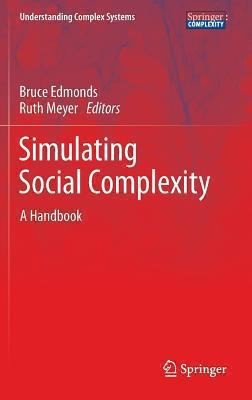
Simulating Social Complexity
0
0
As an Amazon Associate and affiliate partner, Menrva Books earns from qualifying purchases. Learn more
Author Description
Social systems are among the most complex known. This poses particular problems for those who wish to understand them. The complexity often makes analytic approaches infeasible and natural language approaches inadequate for relating intricate cause and effect. However, individual- and agent-based computational approaches hold out the possibility of new and deeper understanding of such systems. Simulating Social Complexity examines all aspects of using agent- or individual-based simulation. This approach represents systems as individual elements having each their own set of differing states and internal processes. The interactions between elements in the simulation represent interactions in the target systems. What makes these elements "social" is that they are usefully interpretable as interacting elements of an observed society. In this, the focus is on human society, but can be extended to include social animals or artificial agents where such work enhances our understanding of human society. The phenomena of interest then result (emerge) from the dynamics of the interaction of social actors in an essential way and are usually not easily simplifiable by, for example, considering only representative actors. The introduction of accessible agent-based modelling allows the representation of social complexity in a more natural and direct manner than previous techniques. In particular, it is no longer necessary to distort a model with the introduction of overly strong assumptions simply in order to obtain analytic tractability. This makes agent-based modelling relatively accessible to a range of scientists. The outcomes of such models can be displayed and animated in ways that also make them more interpretable by experts and stakeholders. This handbook is intended to help in the process of maturation of this new field. It brings together, through the collaborative effort of many leading researchers, summaries of the best thinking and practice in this area and constitu
Menrva's Summary
THE THESIS
The core challenge in understanding human society lies in its inherent complexity, which often renders traditional analytical and natural language approaches insufficient. This book explores the potential of individual- and agent-based computational approaches to provide new and deeper insights into social systems. It focuses on representing systems as individual elements with distinct states and internal processes, where interactions between these elements mirror real-world social dynamics. The aim is to offer a more natural and direct way to model social complexity, moving beyond the need for overly strong assumptions for analytic tractability, thereby making agent-based modeling accessible to a wider range of scientists and stakeholders.
THE SCOPE MAP
- Explanation of agent
- or individual-based simulation for social systems.
- Representation of systems as individual elements with differing states and internal processes.
- Focus on human society, with extensions to social animals or artificial agents.
- Emergence of phenomena from the dynamics of social actor interactions.
- Advantages of agent-based modeling over previous techniques for analytic tractability.
- Accessibility of agent-based modeling to a range of scientists.
- Display and animation of model outcomes for interpretability by experts and stakeholders.
- Contribution to the maturation of the field of social complexity simulation.
THE AUTHORITY PERSPECTIVE
This handbook aims to advance the field of social complexity simulation by consolidating the best thinking and practices from leading researchers. The approach of agent-based modeling is presented as a powerful tool for understanding complex social phenomena that emerge from the interactions of individual actors. By allowing for more natural representation and reducing the need for simplifying assumptions, it makes complex system analysis more accessible. The collaborative effort behind this volume suggests a comprehensive overview intended to guide both researchers and practitioners in this emerging discipline.
Page Count:
754
Publication Date:
2012-01-01
ISBN-10:
3540938125
ISBN-13:
9783540938125
Non-Fiction
Science
Action
Computer Science
Social Science
Simulation
Community Tags
Similar Books