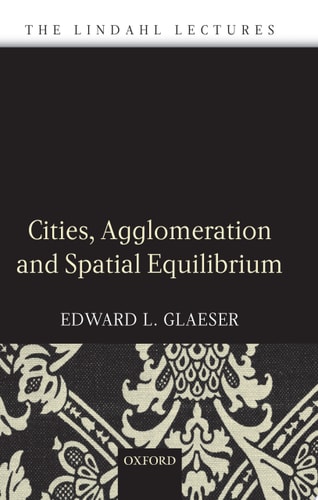
Cities, Agglomeration, and Spatial Equilibrium: The Lindahl Lectures
0
0
As an Amazon Associate and affiliate partner, Menrva Books earns from qualifying purchases. Learn more
Author Description
220 million Americans crowd together in the 3% of the country that is urban. 35 million people live in the vast metropolis of Tokyo, the most productive urban area in the world. The central city of Mumbai alone has 12 million people, and Shanghai almost as many. We choose to live cheek by jowl, in a planet with vast amounts of space. Yet despite all of the land available to us, we choose to live in proximity to cities. Using economics to understand this phenomenon, the urban economist uses the tools of economic theory and empirical data to explain why cities exist and to analyze urban issues such as housing, education, crime, poverty and social interaction.Drawing on the success of his Lindahl lectures, Edward Glaeser provides a rigorous account of his research and unique thinking on cities. Using a series of simple models and economic theory, Glaeser illustrates the primary features of urban economics including the concepts of spatial equilibrium and agglomeration economies. Written for a mathematically inclined audience with an interest in urban economics and cities, the book is written to be accessible to theorists and non-theorists alike and should provide a basis for further empirical work.
Menrva's Summary
THE THESIS
This work investigates the fundamental economic drivers that compel human populations to concentrate in dense urban environments despite the availability of vast amounts of habitable land. Edward L. Glaeser, a prominent urban economist, utilizes a framework of economic theory and empirical data to deconstruct the phenomenon of urban agglomeration. By applying rigorous mathematical models, the author examines how spatial equilibrium dictates the distribution of people and resources across metropolitan landscapes.
THE SCOPE MAP
What You Will Find
- Theoretical models explaining the formation and persistence of urban agglomeration economies.
- Analysis of spatial equilibrium as a mechanism for understanding population distribution.
- Empirical data regarding productivity, housing markets, and social interaction in major global cities.
- Economic perspectives on persistent urban challenges including poverty, crime, and educational disparities.
THE AUTHORITY PERSPECTIVE
Experts recognize this text as a foundational synthesis of modern urban economic theory, particularly valued for its clear application of mathematical models to real-world metropolitan issues. Readers frequently note the academic density of the prose, which serves as a rigorous resource for both theorists and practitioners in the field of urban planning.
Page Count:
275
Publication Date:
2008-09-15
Publisher:
Oxford University Press
ISBN-10:
019929044X
ISBN-13:
9780199290444
Economics
Sociology
Geography
Public Policy
Urban Studies
Community Tags
Similar Books