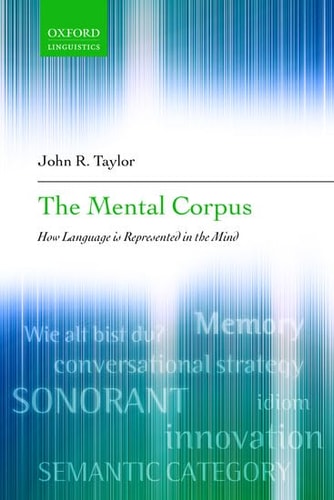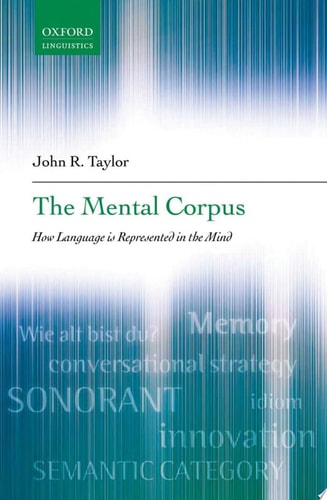
The Mental Corpus: How Language is Represented in the Mind
0
0
As an Amazon Associate and affiliate partner, Menrva Books earns from qualifying purchases. Learn more
Author Description
This book presents a radical reconceptualization of the nature of linguistic knowledge. John Taylor challenges the conventional notion that a language can be understood in terms of the interaction of syntax with a lexicon, the second listing the words and the first the rules for combining them. He proposes instead that an individual's knowledge of a language can be thought of as a repository of memories of linguistic experience. Each encounter with the language, he argues, leaves a trace in our minds. We record the forms of utterances, the concepts and interpretations associated with them, and the contexts in which they were heard or seen. Features of incoming language - a word, a phrase, a meaning, a voice quality, an interactional situation - resonate with items already stored. Similarities between stored items give rise to generalizations of varying degrees of certainty and precision, which in turn are able to sanction new and innovative expressions.John Taylor writes with conviction, clarity, and wit, illustrating every stage of his argument with arresting examples. His account makes a profound and original contribution to understanding the nature of language and the operations of the mind and brain. His book will appeal in equal measure to linguists, philosophers, and cognitive scientists.
Menrva's Summary
THE THESIS
This book investigates the fundamental question of how linguistic knowledge is stored and processed within the human mind. John R. Taylor, a prominent linguist, challenges the traditional modular view of language that separates syntax from the lexicon. Instead, he proposes a usage-based model where language is conceptualized as a vast repository of memories derived from individual linguistic experiences. By analyzing how these stored traces interact with new input, Taylor argues that generalizations emerge from patterns of similarity rather than from abstract, innate rules.
THE SCOPE MAP
What You Will Find
- A critique of the conventional syntax-lexicon dichotomy in linguistics.
- A framework for understanding language as a memory-based system of stored traces.
- Analysis of how linguistic generalizations arise from recurring patterns and similarities.
- Discussion on the intersection of language, cognitive science, and brain function.
THE AUTHORITY PERSPECTIVE
Experts and scholars in the field recognize this work as a significant challenge to generative linguistic paradigms. Readers frequently note the clarity of Taylor's prose, which makes complex cognitive theories accessible to both linguists and philosophers.
Page Count:
384
Publication Date:
2012-07-05
Publisher:
Oxford University Press
ISBN-10:
0199290806
ISBN-13:
9780199290802
Non-Fiction
Linguistics
Psycholinguistics