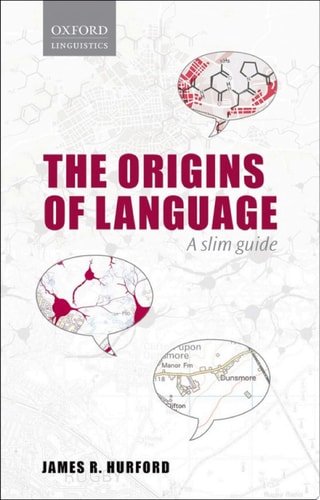
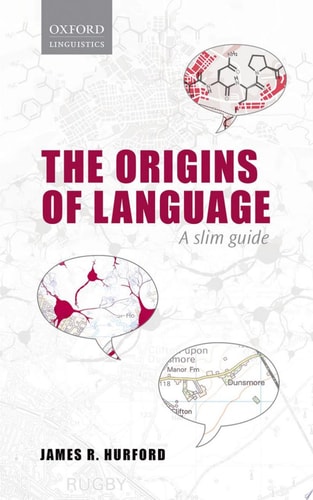
Origins of Language: A Slim Guide
0
0
As an Amazon Associate and affiliate partner, Menrva Books earns from qualifying purchases. Learn more
Author Description
Origins of Language: A Slim Guide offers a concise and accessible overview of what is known about the evolution of the human capacity for language. Non-human animals communicate in simple ways: they may be able to form simple concepts, to feel some limited empathy for others, to cooperate to some extent, and to engage in mind-reading. Human language, however, is characterized by its ability to efficiently express a wide range of subtle and complex meanings. After the first simple beginnings, human language underwent an explosion of complexity, leading to the very complicated systems of grammar and pronunciation found in modern languages. Jim Hurford looks at the very varied aspects of this evolution, covering human prehistory; the relation between instinct and learning; biology and culture; trust, altruism, and cooperation; animal thought; human and non-human vocal anatomy; the meanings and forms of the first words; and the growth of complex systems of grammar and pronunciation. Written by an internationally recognized expert in the field, it draws on a number of disciplines besides linguistics, including philosophy, neuroscience, genetics, and animal behaviour, and will appeal to a wide range of readers interested in language origins and evolution.
Menrva's Summary
THE THESIS
This book investigates the evolutionary origins of the human capacity for language and the transition from simple animal communication to complex grammatical systems. James R. Hurford, a recognized expert in linguistics, synthesizes research from neuroscience, genetics, and animal behavior to explain how human language emerged. He presents a framework that balances biological predispositions with cultural development to account for the rapid expansion of linguistic complexity in human prehistory.
THE SCOPE MAP
What You Will Find
- Analysis of the relationship between instinct and learned behavior in communication
- Comparative study of human and non-human vocal anatomy
- Examination of the role of altruism and cooperation in social signaling
- Overview of the transition from early word formation to complex grammar
Scope Limits
- Does not provide an exhaustive history of every specific language family
- Avoids overly technical mathematical modeling of linguistic evolution
THE AUTHORITY PERSPECTIVE
Experts and readers frequently note the accessibility of this text, which distills complex interdisciplinary research into a concise format. It is widely regarded as a foundational entry point for those seeking a broad overview of language evolution without requiring a background in specialized linguistics.
Page Count:
182
Publication Date:
2014-01-01
Publisher:
OUP Oxford
ISBN-10:
0191009660
ISBN-13:
9780191009662
Non-Fiction
Evolutionary Biology
Anthropology
English & College Success
English
Linguistics
Historical linguistics
Community Tags
Other Editions(3)

Similar Books