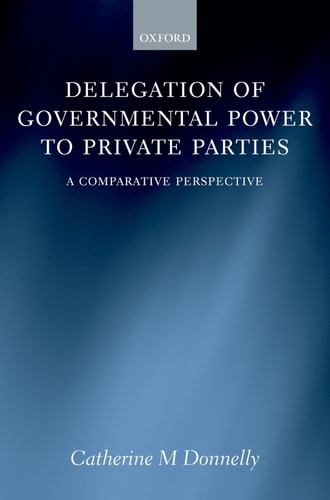
Delegation of Governmental Power to Private Parties: A Comparative Perspective
0
0
As an Amazon Associate and affiliate partner, Menrva Books earns from qualifying purchases. Learn more
Author Description
Through a comparative analysis of England, the European Union, and the United States, this book considers legal responses to delegation of governmental power to private parties. It is argued that although private delegation has the potential to enhance the efficency and effectiveness of governance, it should not be assumed to have this result. Moreover, private delegation creates risks to democracy, accountability, and human rights. Any legal controls must therefore respond to the challenge of enhancing the potential effectiveness of private delegation, while minimising the risks associated with this phenomenon.The legal responses of the three jurisdictions to private delegation are categorised in a two-fold and functional way: responses which impose controls on the delegator of governmental power, and responses which impose contols on the private delegate of governmental power. To secure an appropriate comparative methodology within each category the controls imposed by different legal disciplines such as constitutional law, administrative law, regulatory law, and private law are assessed.Many goals are pursued in this volume. First, the relationship between the different legal responses will be illustrated. It will be argued that the challenge of private delegation is a complex one, which requires a multi-faceted response from a number of different legal disciplines. No one source of legal control is in itself adequate to respond to the challenge. Second, within the discussion of each individual legal control, analysis of appropriate responses to private delegation will be made. Third, it will be shown that at present, the response of all three jurisdictions to private delegation, albeit in differing degrees, is inadequate. A much greater awareness of the risks of private delegation and a greater sense of responsibility on the part of the judiciary are required if the three legal systems are to respond appropriately to the challenge of delegation of governmental power to private parties.
Menrva's Summary
THE THESIS
This book investigates the legal frameworks and regulatory challenges inherent in the delegation of governmental power to private entities across three distinct jurisdictions. Catherine Donelly provides a comparative analysis of England, the European Union, and the United States to evaluate how these systems manage the tension between administrative efficiency and democratic accountability. The author argues that current legal mechanisms are largely inadequate and proposes a multi-faceted approach that integrates constitutional, administrative, and private law to mitigate risks to human rights and public oversight.
THE SCOPE MAP
What You Will Find
- Comparative analysis of legal systems in England, the European Union, and the United States.
- A two-fold functional categorization of legal controls targeting both the delegator and the private delegate.
- Assessment of cross-disciplinary legal controls including constitutional, administrative, regulatory, and private law.
- Evaluation of the risks private delegation poses to democracy, accountability, and human rights.
THE AUTHORITY PERSPECTIVE
Legal scholars and practitioners view this work as a significant contribution to the study of administrative law and the evolving nature of governance. Experts frequently highlight the text for its rigorous comparative methodology and its clear articulation of the systemic failures in current oversight mechanisms.
Page Count:
265
Publication Date:
2008-01-10
Publisher:
Oxford University Press
ISBN-10:
0199298246
ISBN-13:
9780199298242
Private Sector
Government
Law
Great Britain
Administrative Law
United States
Public Policy
Constitutional Law
Community Tags
Similar Books