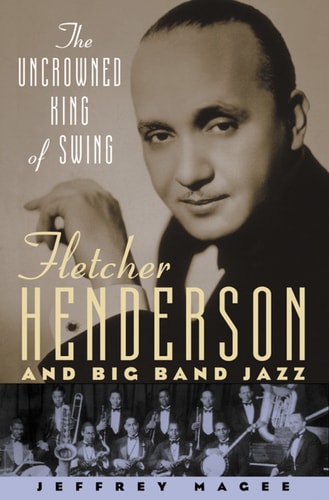
The Uncrowned King of Swing: Fletcher Henderson and Big Band Jazz
0
0
As an Amazon Associate and affiliate partner, Menrva Books earns from qualifying purchases. Learn more
Author Description
If Benny Goodman was the "King of Swing," then Fletcher Henderson was the power behind the throne. Now Jeffrey Magee offers a fascinating account of Henderson's musical career, throwing new light on the emergence of modern jazz and the world that created it. Drawing on an unprecedented combination of sources, including sound recordings and hundreds of scores that have been available only since Goodman's death, Magee illuminates Henderson's musical output, from his early work as a New York bandleader, to his pivotal role in building the Kingdom of Swing. He shows how Henderson, standing at the forefront of the New York jazz scene during the 1920s and '30s, assembled the era's best musicians, simultaneously preserving jazz's distinctiveness and performing popular dance music that reached a wide audience. Magee reveals how, in Henderson's largely segregated musical world, black and white musicians worked together to establish jazz, how Henderson's style rose out of collaborations with many key players, how these players deftly combined improvised and written music, and how their work negotiated artistic and commercial impulses. Whether placing Henderson's life in the context of the Harlem Renaissance or describing how the savvy use of network radio made the Henderson-Goodman style a national standard, Jeffrey Magee brings to life a monumental musician who helped to shape an era. "An invaluable survey of Henderson's life and music."--Don Heckman, Los Angeles Times"Magee has written an important book, illuminating an era too often reduced to its most familiar names. Goodman might have been the King of Swing, but Henderson here emerges as that kingdom's chief architect."--Boston Globe"Excellent.... Jazz fans have waited 30 years for a trained musicologist...to evaluate Henderson's strengths and weaknesses and attempt to place him in the history of American music."--Will Friedwald, New York Sun
Menrva's Summary
THE THESIS
This work investigates the foundational role of Fletcher Henderson in the development of big band jazz and his influence on the broader American musical landscape of the 1920s and 1930s. Jeffrey Magee, a trained musicologist, utilizes an extensive array of primary sources, including previously inaccessible sound recordings and musical scores, to reconstruct Henderson's career. The book argues that Henderson served as the primary architect of the swing era, bridging the gap between improvised jazz and commercial dance music while navigating the racial complexities of the period. By analyzing Henderson's collaborations and professional output, Magee provides a comprehensive framework for understanding the evolution of the big band sound.
THE SCOPE MAP
What You Will Find
- Detailed analysis of Henderson's musical scores and arrangements.
- Historical context regarding the Harlem Renaissance and the rise of network radio.
- Examination of the collaborative dynamics between black and white musicians in a segregated industry.
- Technical evaluation of the synthesis between improvisation and written musical notation.
Scope Limits
- The text focuses primarily on Henderson's professional career and musical output rather than his private personal life.
- The narrative is centered on the New York jazz scene, with less emphasis on regional jazz developments outside of the major urban hubs.
THE AUTHORITY PERSPECTIVE
Critics and musicologists recognize this work as a definitive evaluation of Henderson's contributions to American music history. Readers frequently note the academic density of the prose, which provides a rigorous musicological perspective that fills a long-standing gap in jazz literature.
Page Count:
352
Publication Date:
2005-01-01
Publisher:
Oxford University Press
ISBN-10:
0190282363
ISBN-13:
9780190282363
History
Biography
Musicology
Biography Autobiography
Music History
Humanities
Jazz
Jazz musicians
American History
Big Bands
United States
English
English & College Success
Community Tags
Similar Books