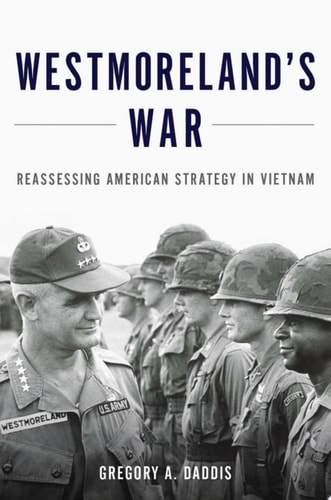
Westmoreland's War: Reassessing American Strategy in Vietnam
0
0
As an Amazon Associate and affiliate partner, Menrva Books earns from qualifying purchases. Learn more
Author Description
General William C. Westmoreland has long been derided for his failed strategy of "attrition" in the Vietnam War. Historians have argued that Westmoreland's strategy placed a premium on high "body counts" through a "big unit war" that relied almost solely on search and destroy missions. Many believe the U.S. Army failed in Vietnam because of Westmoreland's misguided and narrow strategyIn a groundbreaking reassessment of American military strategy in Vietnam, Gregory Daddis overturns conventional wisdom and shows how Westmoreland did indeed develop a comprehensive campaign which included counterinsurgency, civic action, and the importance of gaining political support from the South Vietnamese population. Exploring the realities of a large, yet not wholly unconventional environment, Daddis reinterprets the complex political and military battlefields of Vietnam. Without searching for blame, he analyzes how American civil and military leaders developed strategy and how Westmoreland attempted to implement a sweeping strategic vision.Westmoreland's War is a landmark reinterpretation of one of America's most divisive wars, outlining the multiple, interconnected aspects of American military strategy in Vietnam-combat operations, pacification, nation building, and the training of the South Vietnamese armed forces. Daddis offers a critical reassessment of one of the defining moments in American history.
Menrva's Summary
THE THESIS
This book investigates whether General William C. Westmoreland’s military strategy in Vietnam was as narrow and misguided as traditional historical accounts suggest. Gregory A. Daddis, a military historian and retired U.S. Army colonel, utilizes archival records and primary source documentation to challenge the prevailing narrative of the Vietnam War. He argues that Westmoreland’s strategic vision was far more multifaceted than the singular focus on attrition and body counts often attributed to him. By examining the interplay between civil and military leadership, Daddis provides a nuanced analysis of how the U.S. attempted to balance combat operations with pacification and nation-building efforts.
THE SCOPE MAP
What You Will Find
- An analysis of the integration of counterinsurgency and civic action within American military operations.
- A detailed examination of the political and military complexities inherent in the South Vietnamese environment.
- Primary source evidence regarding the development of strategic vision among American civil and military leaders.
- A comprehensive overview of the four pillars of American strategy: combat operations, pacification, nation building, and the training of South Vietnamese forces.
THE AUTHORITY PERSPECTIVE
Historians and military scholars frequently cite this work as a necessary corrective to the long-standing, simplified critiques of Westmoreland’s command. The text is noted for its rigorous archival research and its ability to provide a balanced, objective view of the strategic challenges faced by American leadership during the conflict.
Page Count:
278
Publication Date:
2013-01-01
Publisher:
Oxford University Press
ISBN-10:
019931652X
ISBN-13:
9780199316526
History
Biography
Military History
Vietnam War
Community Tags
Similar Books