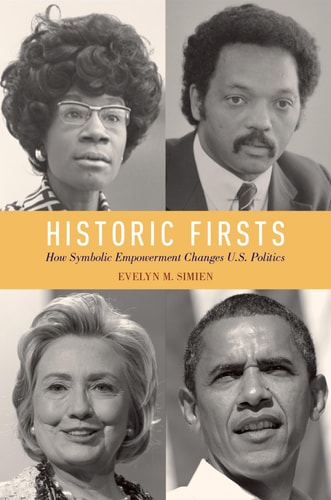
Historic Firsts How Symbolic Empowerment Changes U. S. Politics
0
0
As an Amazon Associate and affiliate partner, Menrva Books earns from qualifying purchases. Learn more
Author Description
The 2008 presidential election made American history. Yet before Barack Obama and Hillary Clinton, there were other "historic firsts": Shirley Chisholm, who ran for president in 1972, and Jesse Jackson, who ran in 1984 and 1988. While unsuccessful, these campaigns were significant, as they rallied American voters across various racial, ethnic, and gender groups. One can also argue that they heightened the electoral prospects of future candidates. Can "historic firsts" bring formerly politically inactive people (those who previously saw no connection between campaigns and their own lives) into the electoral process, making it both relevant and meaningful?In Historic Firsts: How Symbolic Empowerment Changes U.S. Politics, Evelyn M. Simien makes the compelling argument that voters from various racial, ethnic, and gender groups take pride in and derive psychic benefit from such historic candidacies. They make linkages between the candidates in question and their own understanding of representation, and these linkages act to mobilize citizens to vote and become actively involved in campaigns.Where conventional approaches to the study of American political elections tend to focus on socioeconomic factors, or to study race or gender as isolated factors, Simien's approach is intersectional, bringing together literature on both race and gender. In particular she compares the campaigns of Jackson, Chisholm, Obama and Clinton, and she draws upon archival material from campaign speeches, advertising, and newspaper articles, to voter turnout reports, exit polls, and national surveys to discover how race and gender determined the electoral context for the campaigns. In the process, she reveals the differences that exist within and between various racial, ethnic and gender groups in the American political process at the presidential level.
Menrva's Summary
THE THESIS
Does the emergence of "historic firsts" in presidential campaigns effectively mobilize previously inactive voters by providing symbolic empowerment? Evelyn M. Simien, a scholar of political science, utilizes an intersectional framework to analyze how race and gender influence voter behavior. By examining the campaigns of figures such as Shirley Chisholm, Jesse Jackson, Barack Obama, and Hillary Clinton, she argues that these candidacies provide psychic benefits that bridge the gap between personal identity and electoral participation.
THE SCOPE MAP
What You Will Find
- Comparative analysis of presidential campaigns featuring candidates of color and women.
- An intersectional methodology that integrates race and gender studies rather than treating them as isolated variables.
- Empirical evidence derived from archival campaign materials, advertising, exit polls, and national surveys.
- A theoretical framework explaining the link between symbolic representation and voter mobilization.
THE AUTHORITY PERSPECTIVE
Experts recognize this work as a significant contribution to the study of political behavior and representation. Readers frequently note the academic rigor of the intersectional approach, which provides a nuanced understanding of how identity shapes the American electoral process.
Page Count:
176
Publication Date:
2015-01-01
Publisher:
Oxford University Press
ISBN-10:
0199314187
ISBN-13:
9780199314188
Gender Studies
Sociology
United States
American Politics
Elections
Community Tags
Similar Books