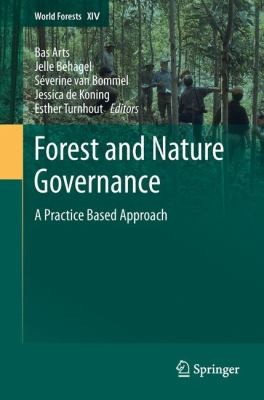
Forest and Nature Governance
0
0
As an Amazon Associate and affiliate partner, Menrva Books earns from qualifying purchases. Learn more
Author Description
Problems such as deforestation, biodiversity loss and illegal logging have provoked various policy responses that are often referred to as forest and nature governance. In its broadest interpretation, governance is about the many ways in which public and private actors from the state, market and/or civil society govern public issues at multiple scales. Examples range from the United Nations’ Convention on Biological Diversity to national forest programmes. In studies of forest and nature governance the dominant approaches are rational choice and neo-institutionalism. This book takes another perspective. Departing from ‘practice theory’, and building upon scholars like Giddens, Bourdieu, Reckwitz, Schatzki and Callon, it seeks to move beyond established understandings of institutions, actors, and knowledge. In so doing, the book not only presents an innovative conceptual and methodological framework for a practice based approach, but also rich case studies and ethnographies. Examples are participatory forest management in the tropics, REDD policy at global level, European water policy, forest certification and the construction of global biodiversity databases. Taking social practices as the key unit of analysis, this book describes how different practitioners, ranging from local forest managers on the ground to policy makers at the global level, work with trees, forests, biodiversity, wildlife, and so on, and act upon forest policies, environmental discourses, codes of conduct, or scientific insights. It is also about how communities, NGOs, stakeholders, and citizens get involved in forest and nature governance.
Menrva's Summary
THE THESIS
This book investigates how forest and nature governance is enacted through social practices rather than solely through institutions and actors. It moves beyond established understandings by employing practice theory, drawing on scholars like Giddens, Bourdieu, and Callon, to analyze how diverse practitioners engage with environmental issues. The work presents an innovative conceptual and methodological framework, supported by rich case studies and ethnographies, to understand the micro-level actions that shape policy and discourse.
THE SCOPE MAP
- A practice-based conceptual and methodological framework for analyzing forest and nature governance.
- Case studies and ethnographies of participatory forest management in the tropics.
- Analysis of REDD policy at the global level.
- Examination of European water policy through a practice lens.
- Discussion of forest certification processes.
- Exploration of the construction of global biodiversity databases.
- An examination of how communities, NGOs, stakeholders, and citizens engage in governance.
THE AUTHORITY PERSPECTIVE
The book offers a novel perspective on forest and nature governance by centering social practices, moving away from traditional institutional and actor-based analyses. Its approach, grounded in practice theory and supported by diverse case studies from global to local scales, provides a rich empirical and theoretical contribution. The work is likely to appeal to scholars and practitioners interested in environmental policy, sociology, and the practical implementation of governance frameworks. The detailed ethnographies and conceptual innovations suggest a text that challenges established understandings and opens new avenues for research.
Page Count:
265
Publication Date:
2012-01-01
ISBN-10:
9400751125
ISBN-13:
9789400751125
Politics
Science
Non-Fiction
Nature
Biodiversity
Forestry
Sociology
Community Tags
Similar Books