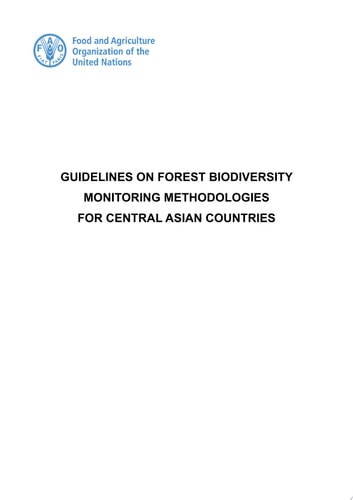
Guidelines on Forest Biodiversity Monitoring Methodologies for Central Asian Countries
0
0
As an Amazon Associate and affiliate partner, Menrva Books earns from qualifying purchases. Learn more
Author Description
For effective forest biodiversity monitoring in FAO Sub-regional Office for Central Asia (SEC) countries (Azerbaijan, Kazakhstan, Kyrgyzstan, Tajikistan, Turkmenistan, Uzbekistan and Türkiye), it is important to develop cost-effective and efficient monitoring methods. The main purpose of the guidelines on forest biodiversity monitoring methodologies is to support FAOSEC countries in their efforts to detect changes in forest biodiversity and to ensure that appropriate measures are taken for sustainable forest management. The monitoring process begins with the assessment of monitoring requirements and the establishment of specific goals for the subsequent development of the monitoring approach. Subsequently, essential factors such as indicators, methods and tools for monitoring, team composition, frequency of monitoring, and data management are identified to shape the monitoring initiative, integrating aspects related to the state, impact, and response. The monitoring process is then concluded through the practical implementation of the program via field investigations, analysis and interpretation of the gathered information, and dissemination of resultant reports to pertinent stakeholders. The guidelines for forest biodiversity monitoring methodologies employ this comprehensive five-step monitoring cycle as a foundation for crafting an efficient forest biodiversity monitoring program. The guidelines on forest biodiversity monitoring methodologies are designed to take into account the changes in pressure, state and response indicators especially for biodiversity monitoring with the contributions of subject-matter experts. This study uses the "Pressure-State-Response" framework that has been frequently used in different global, regional, and national monitoring programs. In the guidelines, monitoring targets for species, habitats, ecosystem services, and forestry practices are defined for each monitoring component by using relevant indicators. Using Türki
Menrva's Summary
THE THESIS
This document outlines a comprehensive five-step methodology for forest biodiversity monitoring tailored for Central Asian countries. The guidelines aim to support Azerbaijan, Kazakhstan, Kyrgyzstan, Tajikistan, Turkmenistan, Uzbekistan, and Türkiye in detecting changes in forest biodiversity and implementing sustainable forest management practices. It details the process from assessing monitoring requirements and setting goals to identifying essential factors like indicators, methods, team composition, monitoring frequency, and data management, all framed within the Pressure-State-Response model. The final stage involves practical implementation through field investigations, data analysis, interpretation, and dissemination of reports to stakeholders.
THE SCOPE MAP
- A detailed framework for assessing monitoring requirements and establishing specific goals for forest biodiversity initiatives.
- Identification of key indicators, methods, and tools for effective monitoring, considering species, habitats, ecosystem services, and forestry practices.
- Guidance on team composition, optimal monitoring frequency, and robust data management strategies.
- Integration of the "Pressure-State-Response" framework for analyzing environmental changes.
- Practical steps for field implementation, data analysis, interpretation, and reporting to relevant stakeholders.
- Consideration of biodiversity monitoring challenges and opportunities specific to Central Asian countries.
THE AUTHORITY PERSPECTIVE
The guidelines are designed to provide a practical and cost-effective approach to forest biodiversity monitoring for FAO Sub-regional Office for Central Asia (SEC) countries. The methodology emphasizes a structured, five-step cycle and integrates the widely-used "Pressure-State-Response" framework. By defining monitoring targets for species, habitats, ecosystem services, and forestry practices using relevant indicators, the document aims to equip these nations with the tools necessary for sustainable forest management and informed decision-making.
Page Count:
106
Publication Date:
2023-10-06
Publisher:
Food & Agriculture Org.
ISBN-10:
9251380562
ISBN-13:
9789251380567
Science
Non-Fiction
Biodiversity
Forestry
Central Asia
Community Tags
Similar Books




Reader Comments
Share Your Thoughts
No comments yet. Be the first to share your thoughts!