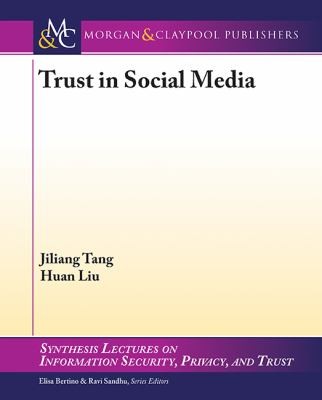
Trust In Social Media
0
0
As an Amazon Associate and affiliate partner, Menrva Books earns from qualifying purchases. Learn more
Author Description
Social media greatly enables people to participate in online activities and shatters the barrier for online users to create and share information at any place at any time. However, the explosion of user-generated content poses novel challenges for online users to find relevant information, or, in other words, exacerbates the information overload problem. On the other hand, the quality of user-generated content can vary dramatically from excellence to abuse or spam, resulting in a problem of information credibility. The study and understanding of trust can lead to an effective approach to addressing both information overload and credibility problems. Trust refers to a relationship between a trustor (the subject that trusts a target entity) and a trustee (the entity that is trusted). In the context of social media, trust provides evidence about with whom we can trust to share information and from whom we can accept information without additional verification. With trust, we make the mental shortcut by directly seeking information from trustees or trusted entities, which serves a two-fold purpose: without being overwhelmed by excessive information (i.e., mitigated information overload) and with credible information due to the trust placed on the information provider (i.e., increased information credibility). Therefore, trust is crucial in helping social media users collect relevant and reliable information, and trust in social media is a research topic of increasing importance and of practical significance. This book takes a computational perspective to offer an overview of characteristics and elements of trust and illuminate a wide range of computational tasks of trust. It introduces basic concepts, deliberates challenges and opportunities, reviews state-of-the-art algorithms, and elaborates effective evaluation methods in the trust study. In particular, we illustrate properties and representation models of trust, elucidate trust prediction with representative algor
Menrva's Summary
THE THESIS
This book investigates the computational aspects of trust in social media to address the challenges of information overload and credibility. The author, Huan Liu, a computational perspective expert, examines how trust mechanisms can help users navigate the vast amount of user-generated content, distinguishing reliable information from spam or misinformation. The book delves into the fundamental concepts of trust, exploring its characteristics, representation models, and the computational tasks involved in predicting and managing trust within social media platforms. It aims to provide a comprehensive overview of the current state of research and effective evaluation methods in this critical area.
THE SCOPE MAP
- Properties and representation models of trust in social media.
- Elucidation of trust prediction with representative algorithms.
- Discussion of challenges and opportunities in trust research.
- Review of state-of-the-art algorithms for trust computation.
- Elaboration on effective evaluation methods for trust studies.
- A computational perspective on understanding and managing online trust.
THE AUTHORITY PERSPECTIVE
The book offers a computational perspective on the crucial topic of trust in social media, addressing the pervasive issues of information overload and credibility. It systematically breaks down the concept of trust, detailing its properties, representation, and prediction through computational models. The work is positioned as a valuable resource for researchers and practitioners seeking to understand the algorithms and evaluation methods employed in this domain. The detailed exploration of computational tasks suggests a text aimed at those with a technical background interested in the mechanics of online trust.
Page Count:
115
Publication Date:
2014-01-01
ISBN-10:
1627054049
ISBN-13:
9781627054041
Science & Technology
Non-Fiction
Information Science
Social Media
Computer Science
Community Tags
Similar Books