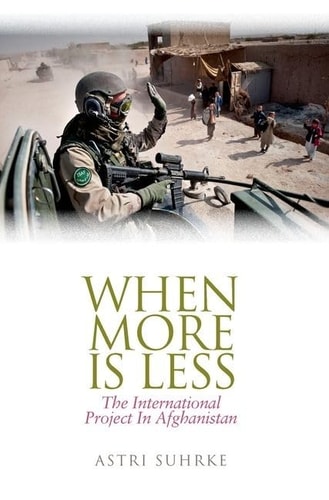
When More Is Less: The International Project in Afghanistan
0
0
As an Amazon Associate and affiliate partner, Menrva Books earns from qualifying purchases. Learn more
Author Description
The Western-led efforts to establish a new post-Taliban order in Afghanistan are in serious trouble, and in this book Suhrke sets out to explain why. She begins with the dynamic of the intervention and its related peace-building mission. What were the forces shaping this grand international project? What explains the apparent systemic bias towards a deeper and broader international involvement? Many reasons have been cited for its limited achievements and ever-growing difficulties, the most common explanation being that the national, regional, and international contexts were unfavourable. But many policies were misguided while the multinational operation itself was extraordinarily and unnecessarily complex. Astri Suhrke's main thesis is that the international project itself contains serious tensions and contradictions that significantly contributed to the lack of progress. As a result, the deepening involvement proved dysfunctional: massive international support has created an extreme version of a rentier state that is predictably weak, corrupt and unaccountable; US-led military operations undercut the peacebuilding agenda, and more international aid and monitoring to correct the problems generate Afghan resentment and evasion. Continuing these policies will only reinforce the dynamic. The alternative is a less intrusive international presence, a longer time-frame for reconstruction and change, and negotiations with the militants that can end the war and permit a more Afghan-directed order to emerge.
Menrva's Summary
THE THESIS
This book investigates why the international intervention in post-Taliban Afghanistan failed to achieve its objectives despite massive resource mobilization. Astri Suhrke, a senior researcher with decades of experience in the region, argues that the international project was fundamentally flawed by internal contradictions. By analyzing the interplay between military operations and peacebuilding efforts, she demonstrates how the intervention created a dysfunctional rentier state that undermined its own goals of stability and accountability.
THE SCOPE MAP
What You Will Find
- Analysis of the systemic bias toward deeper international involvement in post-conflict states.
- Examination of the structural tensions between US-led military operations and civilian peacebuilding agendas.
- Evaluation of the economic and political consequences of creating a rentier state in Afghanistan.
- Proposed alternative strategies including reduced international presence and negotiated settlements with militants.
THE AUTHORITY PERSPECTIVE
Experts and political analysts recognize this work as a critical, evidence-based critique of international interventionism. Readers frequently note the academic rigor and the author's deep contextual knowledge of the Afghan political landscape.
Page Count:
293
Publication Date:
2011-12-27
Publisher:
Oxford University Press
ISBN-10:
0199327564
ISBN-13:
9780199327560
History
Politics
Afghanistan
Foreign Policy
Asia
World politics
Military History
International relations
Community Tags
Similar Books