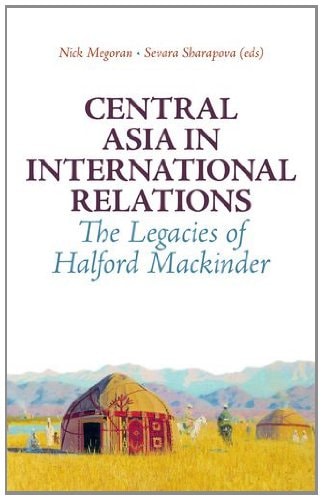
Central Asia in International Relations: The Legacies of Halford Mackinder
0
0
As an Amazon Associate and affiliate partner, Menrva Books earns from qualifying purchases. Learn more
Author Description
The republics of Central Asia re-emerged as independent actors in the global interstate system in the wake of the collapse of the Soviet Union, their varied histories and geographies offering many different possible opportunities and course of action. In order to explain their often confusing and complicated foreign policy alignments, many analysts have turned again to the theories of Sir Halford Mackinder (1861-1947), the British geographer who is widely regarded as the founding father of geopolitics. This book brings together historical geographers and political scientists to explore this remarkable renaissance of Mackinder's thinking. It charts his own engagement with the region, in both his writings and his visit to Central Asia as a British envoy in the aftermath of World War I. It outlines and evaluates how his ideas have been used by Central Asian, Russian, and American scholars to explain the region's international relations, and it traces how his writings actually reached Central Asia and the manner in which they have been dynamically reworked by scholars 'in transit'. The book is thus an important contribution not only to theorising the international relations of Central Asia, but also to our understanding of the historical geography of how ideas are ex- changed and reworked in the process.
Menrva's Summary
THE THESIS
This book investigates the enduring influence of Sir Halford Mackinder’s geopolitical theories on the contemporary international relations and foreign policy alignments of post-Soviet Central Asian states. Nick Megoran, a scholar specializing in political geography, assembles a multidisciplinary team of historical geographers and political scientists to evaluate how Mackinder’s early 20th-century frameworks are currently interpreted and applied by regional and global actors. The text provides a critical analysis of how these classical theories are not merely imported but are dynamically reworked by scholars within the region to navigate modern geopolitical complexities.
THE SCOPE MAP
What You Will Find
- Historical analysis of Mackinder’s personal engagement with Central Asia during his tenure as a British envoy.
- Comparative evaluation of how Russian, American, and Central Asian scholars utilize geopolitical theory.
- Examination of the intellectual transmission and transformation of ideas across borders.
- Theoretical framework for understanding the foreign policy trajectories of post-Soviet republics.
THE AUTHORITY PERSPECTIVE
Experts recognize this work as a significant contribution to the study of geopolitical theory and its practical application in regional politics. Readers frequently note the academic density of the prose, which serves as a foundational text for those studying the intersection of geography and international relations.
Page Count:
256
Publication Date:
2013-03-19
Publisher:
Oxford University Press
ISBN-10:
0199327971
ISBN-13:
9780199327973
Historical geography
International relations
Central Asia
Geopolitics
Community Tags
Similar Books