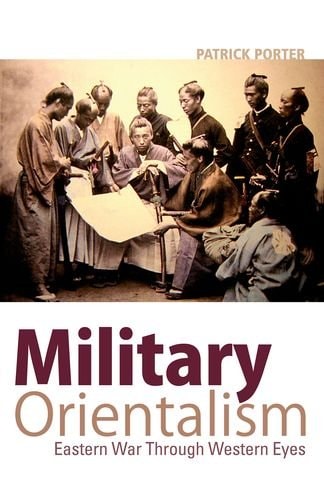
Military Orientalism: Eastern War Through Western Eyes
0
0
As an Amazon Associate and affiliate partner, Menrva Books earns from qualifying purchases. Learn more
Author Description
From the Ancient Greeks' obsession with the armies of the Persians, Westerners have been irresistibly drawn to the exotic nature of "Oriental" warfare and have sought either to emulate their enemies' imagined ways of fighting or to incorporate Eastern warriors and "martial races," such as the Sikhs and Gurkhas, in their own forces. The alluring yet terrifying prospect of Samurai warriors, obedient to an ancient code of chivalry, or of the Mongol cavalry thundering across the steppes, continue to grip our imagination, while the courage and fighting prowess of today's "Eastern" warriors, the Taliban and Hezbollah, have been grudgingly acknowledged by the high tech armies of NATO in Afghanistan and the IDF in Lebanon. Such romantic notions are based on a highly questionable premise, namely that race, culture and tradition are separate and primordial, and that they determine how societies fight. But how far does culture shape war? Do non-Westerners approach strategy, combat, or death in ways intrinsically different from their Eastern neighbours? This debate can be tracked through time, from Herodotus onwards, and features in innumerable histories and literary works as well as in poetry, art and oral epics. Yet there are few histories of the idea itself. Military Orientalism argues that viewing culture as a script that dictates warfare is wrong, and that our obsession with the exotic can make it harder, not easier, to know the enemy. Culture is powerful, but it is an ambiguous repertoire of ideas rather than a clear code for action. To divide the world into western, Asiatic or Islamic ways of war is a delusion, one whose profound impact affects contemporary war and above all the War on Terror. Porter's fascinating book explains why the "Oriental" warrior inspires fear, envy and wonder and how this has shaped the way Western armies fight.
Menrva's Summary
THE THESIS
This book investigates the persistent Western tendency to view non-Western warfare through the lens of cultural and racial essentialism, arguing that such perceptions distort strategic reality. Patrick Porter, a scholar of military history and international relations, examines how historical narratives from Herodotus to the modern War on Terror have constructed the myth of the 'Oriental' warrior. He posits that culture is an ambiguous repertoire of ideas rather than a deterministic script, and that the Western obsession with exoticizing enemy combatants undermines effective military intelligence and decision-making.
THE SCOPE MAP
What You Will Find
- Historical analysis of Western perceptions of Eastern warfare from Ancient Greece to the present.
- A critique of the 'martial race' theory and its application to groups like the Sikhs and Gurkhas.
- Examination of contemporary conflicts including the War on Terror, the Taliban, and Hezbollah.
- Theoretical framework challenging the notion that culture acts as a rigid, predictive code for combat behavior.
THE AUTHORITY PERSPECTIVE
Experts recognize this work as a critical intervention in military studies that challenges long-standing biases in strategic thought. Readers frequently note the academic rigor of the prose and the author's ability to synthesize vast historical periods into a coherent argument about modern geopolitical failures.
Page Count:
256
Publication Date:
2009-06-22
Publisher:
Oxford University Press
ISBN-10:
0199326258
ISBN-13:
9780199326259
History
War Studies
Sociology
International relations
Military History
Community Tags
Other Editions(2)
Similar Books



Reader Comments
Share Your Thoughts
No comments yet. Be the first to share your thoughts!