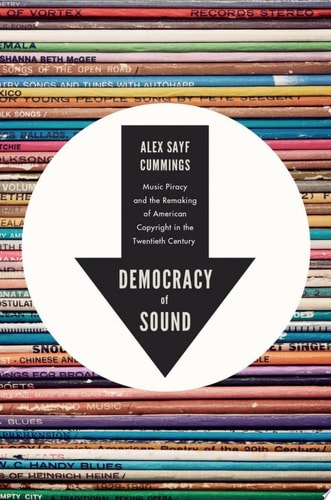
Democracy of Sound: Music Piracy and the Remaking of American Copyright in the Twentieth Century
0
0
As an Amazon Associate and affiliate partner, Menrva Books earns from qualifying purchases. Learn more
Author Description
It was a time when music fans copied and traded recordings without permission. An outraged music industry pushed Congress to pass anti-piracy legislation. Yes, that time is now; it was also the era of Napster in the 1990s, of cassette tapes in the 1970s, of reel-to-reel tapes in the 1950s, even the phonograph epoch of the 1930s. Piracy, it turns out, is as old as recorded music itself. In Democracy of Sound, Alex Sayf Cummings uncovers the little-known history of music piracy and its sweeping effects on the definition of copyright in the United States. When copyright emerged, only visual material such as books and maps were thought to deserve protection; even musical compositions were not included until 1831. Once a performance could be captured on a wax cylinder or vinyl disc, profound questions arose over the meaning of intellectual property. Is only a written composition defined as a piece of art? If a singer performs a different interpretation of a song, is it a new and distinct work? Such questions have only grown more pressing with the rise of sampling and other forms of musical pastiche. Indeed, music has become the prime battleground between piracy and copyright. It is compact, making it easy to copy. And it is highly social, shared or traded through social networks--often networks that arise around music itself. But such networks also pose a counter-argument: as channels for copying and sharing sounds, they were instrumental in nourishing hip-hop and other new forms of music central to American culture today. Piracy is not always a bad thing. An insightful and often entertaining look at the history of music piracy, Democracy of Sound offers invaluable background to one of the hot-button issues involving creativity and the law.
Menrva's Summary
THE THESIS
This book investigates the historical tension between music piracy and the evolution of American copyright law throughout the twentieth century. Alex Sayf Cummings, a historian, utilizes archival research and legal analysis to argue that piracy has been a persistent, formative force in shaping intellectual property definitions. By examining the transition from physical media like wax cylinders to digital formats, the author demonstrates how the music industry's reaction to unauthorized copying has consistently redefined the legal boundaries of artistic ownership.
THE SCOPE MAP
What You Will Find
- A historical timeline of music piracy spanning from the 1930s phonograph era to the 1990s Napster phenomenon.
- An analysis of the legal evolution of copyright as applied to recorded performances versus written compositions.
- Examination of the role of social networks in both facilitating piracy and fostering new musical genres like hip-hop.
- Case studies on the impact of cassette tapes, reel-to-reel recordings, and digital sampling on legislative policy.
THE AUTHORITY PERSPECTIVE
Experts and legal scholars recognize this work as a comprehensive historical account of the intersection between creative expression and regulatory frameworks. Readers frequently note the clarity with which the author connects past technological shifts to contemporary debates regarding digital intellectual property.
Page Count:
272
Publication Date:
2013-01-01
Publisher:
Oxford University Press
ISBN-10:
0199323720
ISBN-13:
9780199323722
History
Music
Sound recordings
Technology
Copyright
American History
Law
Special Topics
Humanities
Community Tags
Similar Books