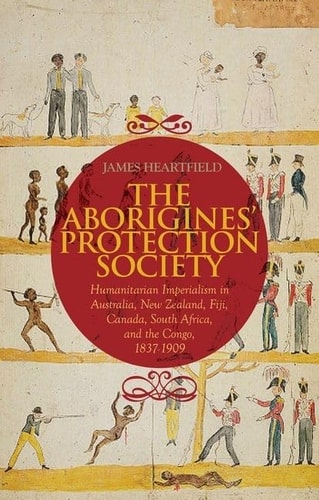
Aborigines' Protection Society: Humanitarian Imperialism in Australia, New Zealand, Fiji, Canada, South Africa, and the Congo, 1836-1909
0
0
As an Amazon Associate and affiliate partner, Menrva Books earns from qualifying purchases. Learn more
Author Description
For more than seventy years, the Aborigines' Protection Society, a select group of the great and the good, fought for the natives of the British Empire and against the tide of white supremacy to defend the interests of aboriginal peoples everywhere. Active on four continents, the Society brought the Zulu King Cetshwayo to meet Queen Victoria, and Maori rebels to the Lord Mayor's banqueting hall. The Society's supporters were denounced by senior British Army officers and white settlers as Zulu-lovers, 'so-called friends of the Aborigines', and even traitors. The book tells the story of the three-cornered fight among the Colonial Office, the settlers and the natives that shaped the Empire and the pivotal role that the Society played, persuading the authorities to limit settlers' claims in the name of native interests. Against expectations, the policy of native protection turned out to be one of the most important reasons for the growth of Imperial rule. James Heartfield's comparative study of native protection policies in Southern Africa, the Congo, New Zealand, Fiji, Australia, and Canada explains how those who held the best of intentions ended up unwittingly championing further colonisation. Pointing to the wreckage of humanitarian imperialism today, Heartfield sets out to understand its roots in the beliefs and practices of its nineteenth-century equivalents.
Menrva's Summary
THE THESIS
This work investigates how the nineteenth-century Aborigines' Protection Society, despite its humanitarian intentions, inadvertently facilitated the expansion of British imperial rule. James Heartfield, a scholar of political history, utilizes extensive archival research to examine the complex power dynamics between the Colonial Office, white settlers, and indigenous populations. He argues that the Society's advocacy for native protection often provided the moral and administrative justification for increased state intervention, ultimately entrenching colonial control across multiple continents.
THE SCOPE MAP
What You Will Find
- Comparative analysis of colonial policies in Australia, New Zealand, Fiji, Canada, South Africa, and the Congo.
- Examination of the ideological shift from humanitarian advocacy to imperial administration.
- Primary source documentation regarding the interactions between the Society, British officials, and indigenous leaders.
- A critical framework for understanding the historical roots of modern humanitarian interventionism.
THE AUTHORITY PERSPECTIVE
Experts and reviewers recognize this text as a rigorous, well-researched contribution to the study of British imperial history. Scholars frequently note the book's ability to synthesize complex, geographically diverse colonial projects into a cohesive argument about the unintended consequences of humanitarian activism.
Page Count:
288
Publication Date:
2011-06-14
Publisher:
Oxford University Press
ISBN-10:
0199327408
ISBN-13:
9780199327409
History
Great Britain
Human rights
Colonialism
British Empire
Community Tags
Similar Books