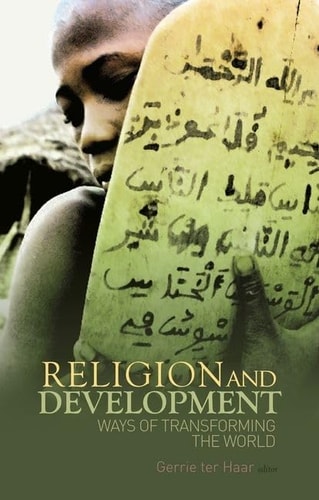
Religion and Development: Ways of Transforming the World
0
0
As an Amazon Associate and affiliate partner, Menrva Books earns from qualifying purchases. Learn more
Author Description
Until recently, policy-makers and academics generally saw religion as something that would disappear as countries made economic progress. But we now know that this rarely happens in fact. People in most countries continue to look at the world through the prism of religion even when they develop modern lifestyles. Religion and Development looks at the ways in which a religious worldview influences processes of development. Its great originality is that it does not concentrate primarily on religious institutions and organisations but on religious ideas themselves. In the final resort, it is people's ideas that motivate them. Their worldview stimulates them to act in specific ways. Religion is a dimension of life that often lies behind qualities such as social trust and cohesion that are vital to development. This is of growing importance in a world where technocratic visions of development have lost their way. For communities where religious belief is accepted as a fact of everyday life, religion constitutes a major resource. It can be employed by people who want to destroy society as well as those who want to build it. The contributors to this book explore how religious resources can be harnessed for development. Many of the world's people believe that the material advancement of both individuals and communities is inseparable from their spiritual improvement. The essays in this volume take this point of view seriously.
Menrva's Summary
THE THESIS
This volume investigates how religious worldviews and ideas function as primary drivers in the processes of global development, challenging the secularization hypothesis. Gerrie ter Haar, a scholar in the field of religion and development, assembles a collection of essays that shift the focus from institutional religious structures to the internal belief systems of individuals. The text argues that because religious ideas motivate human action and foster social cohesion, they represent a critical, often overlooked resource for sustainable development in modern societies.
THE SCOPE MAP
What You Will Find
- Analysis of the intersection between spiritual belief and material advancement.
- Examination of how religious worldviews influence social trust and community cohesion.
- Case studies exploring the dual potential of religion to either hinder or facilitate societal growth.
- A critique of purely technocratic approaches to international development.
THE AUTHORITY PERSPECTIVE
Experts recognize this work as a significant contribution to development studies for its focus on the agency of individual belief rather than institutional politics. Readers frequently note the academic rigor of the essays, which provide a necessary framework for understanding the role of faith in contemporary global policy.
Page Count:
320
Publication Date:
2011-06-14
Publisher:
Oxford University Press
ISBN-10:
0199327475
ISBN-13:
9780199327478
Economics
Religion
New Used & Rental Textbooks
Sociology
Social Science
Community Tags
Similar Books