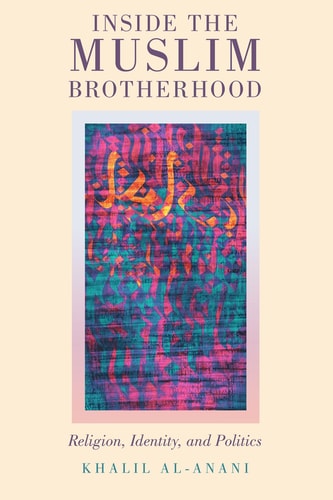
Inside the Muslim Brotherhood: Religion and Global Politics
0
0
As an Amazon Associate and affiliate partner, Menrva Books earns from qualifying purchases. Learn more
Author Description
Over the past three decades, through rises and falls in power, regime repression and exclusion, the Egyptian Muslim Brotherhood has endured, proving more resilient than any other Islamist movement in the world. In this book Khalil al-Anani explores the factors that have enabled the Brotherhood to survive so long within an ever-changing political landscape.Inside the Muslim Brotherhood unpacks the principal factors that shape the movement's identity, organization, and activism. Investigating the processes of socialization, indoctrination, recruitment, identification, networking, and mobilization that characterize the movement, al-Anani argues that the Brotherhood is not merely a political actor seeking power but an identity-maker that aims to change societal values, norms, and morals to line up with its ideology and worldview. The Brotherhood is involved in an intensive process of meaning construction and symbolic production that shapes individuals' identity and gives sense to their lives. The result is a distinctive code of identity that binds members together, maintains their activism, and guides their behavior in everyday life. Al-Anani attributes the Brotherhood's longevity to its tight-knit structure coupled with a complex membership system that has helped them resist regime penetration. The book also explores the divisions and differences within the movement and how these affect its strategy and decisions.The culmination of over a decade of research and interviews with leaders and members of the movement, this book challenges the dominant narratives about Islamists and Islamism as a whole.
Menrva's Summary
THE THESIS
What mechanisms of socialization and identity construction have allowed the Egyptian Muslim Brotherhood to maintain organizational resilience and longevity despite decades of state repression? Khalil al-Anani, a scholar specializing in Middle Eastern politics, utilizes over a decade of primary research and interviews with movement members to analyze the Brotherhood. He argues that the organization functions primarily as an identity-maker rather than a traditional political actor, focusing on the internal processes that bind members to a specific ideological worldview. By examining the intersection of recruitment, indoctrination, and social networking, the author provides a framework for understanding how the group resists external penetration and adapts to shifting political landscapes.
THE SCOPE MAP
What You Will Find
- Analysis of internal socialization, recruitment, and indoctrination processes.
- Examination of the movement's symbolic production and identity construction.
- Discussion of organizational structure and its role in resisting state repression.
- Insights into internal divisions and strategic decision-making processes.
Scope Limits
- The study focuses primarily on the Egyptian branch of the Muslim Brotherhood.
- The text does not provide a comprehensive history of every regional affiliate of the global movement.
THE AUTHORITY PERSPECTIVE
Experts in Middle Eastern studies identify this work as a significant contribution to the understanding of Islamist organizational behavior. Readers frequently note the academic rigor and the depth of the author's primary source interviews, which provide a nuanced view of the movement's internal dynamics.
Page Count:
220
Publication Date:
2020-01-01
Publisher:
Oxford University Press
ISBN-10:
0190073594
ISBN-13:
9780190073596
Religion
History
Sociology
Islamism
New Used & Rental Textbooks
World
Church & State
Religious
Law
Middle Eastern
Islam
Community Tags
Similar Books