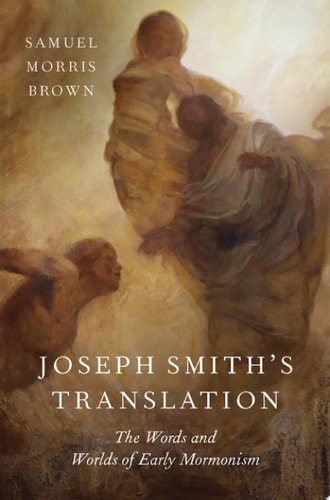
Joseph Smith's Translation: The Words and Worlds of Early Mormonism
0
0
As an Amazon Associate and affiliate partner, Menrva Books earns from qualifying purchases. Learn more
Author Description
Mormonism's founder, Joseph Smith, claimed to have translated ancient scriptures. He dictated an American Bible from metal plates reportedly buried by ancient Jews in a nearby hill, and produced an Egyptian "Book of Abraham" derived from funerary papyri he extracted from a collection of mummies he bought from a traveling showman. In addition, he rewrote sections of the King James Version as a "New Translation" of the Bible. Smith and his followers used the term translation to describe the genesis of these English scriptures, which remain canonical for the Church of Jesus Christ of Latter-day Saints. Whether one believes him or not, the discussion has focused on whether Smith's English texts represent literal translations of extant source documents. On closer inspection, though, Smith's translations are far more metaphysical than linguistic. In Joseph Smith's Translation, Samuel Morris Brown argues that these translations express the mystical power of language and scripture to interconnect people across barriers of space and time, especially in the developing Mormon temple liturgy. He shows that Smith was devoted to an ancient metaphysics--especially the principle of correspondence, the concept of "as above, so below"--that provided an infrastructure for bridging the human and the divine as well as for his textual interpretive projects. Joseph Smith's projects of metaphysical translation place Mormonism at the productive edge of the transitions associated with shifts toward "secular modernity." This transition into modern worldviews intensified, complexly, in nineteenth-century America. The evolving legacies of Reformation and Enlightenment were the sea in which early Mormons swam, says Brown. Smith's translations and the theology that supported them illuminate the power and vulnerability of the Mormon critique of American culture in transition. This complex critique continues to resonate and illuminate to the present day.
Menrva's Summary
THE THESIS
How did Joseph Smith’s concept of translation function as a metaphysical bridge between the human and the divine rather than a literal linguistic act? Samuel Morris Brown, a scholar of early Mormonism, utilizes historical analysis and theological inquiry to argue that Smith’s scriptural projects were rooted in an ancient metaphysics of correspondence. By examining the cultural context of nineteenth-century America, Brown demonstrates how these translations served as a mechanism for connecting individuals across time and space within the developing Mormon temple liturgy.
THE SCOPE MAP
What You Will Find
- Analysis of the Book of Mormon, the Book of Abraham, and the Joseph Smith Translation of the Bible.
- Exploration of the principle of correspondence and its role in early Mormon theology.
- Examination of the intersection between Reformation legacies, Enlightenment thought, and American religious innovation.
Scope Limits
- The text does not provide a linguistic verification of the source documents against Smith's English output.
- The analysis focuses primarily on the metaphysical and theological implications rather than a biographical account of Smith's life.
THE AUTHORITY PERSPECTIVE
Scholars and historians of religion frequently note the academic rigor and depth of Brown's analysis regarding the intellectual history of early Mormonism. Experts highlight this work as a significant contribution to understanding the intersection of nineteenth-century American culture and the development of unique Mormon theological frameworks.
Page Count:
314
Publication Date:
2020-01-01
Publisher:
Oxford University Press
ISBN-10:
0190054255
ISBN-13:
9780190054250
Philosophy
Religion
History
Mormonism
Translating
Translating and interpreting
New Used & Rental Textbooks
Christian Denominations & Sects
Mormon Church
Philosophy of
Special Topics
Theology
Jesus Christ
Sacred books
American History
Community Tags
Similar Books