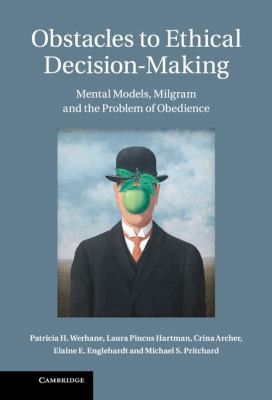
Obstacles to Ethical Decision-Making: Mental Models, Milgram, and the Problem of Obedience
0
0
As an Amazon Associate and affiliate partner, Menrva Books earns from qualifying purchases. Learn more
Author Description
In commerce, many moral failures are due to narrow mindsets that preclude taking into account the moral dimensions of a decision or action. In turn, sometimes these mindsets are caused by failing to question managerial decisions from a moral point of view, because of a perceived authority of management. In the 1960s, Stanley Milgram conducted controversial experiments to investigate just how far obedience to an authority figure could subvert his subjects' moral beliefs. In this thought-provoking work, the authors examine the prevalence of narrow mental models and the phenomenon of obedience to an authority to analyse and understand the challenges which business professionals encounter in making ethical decisions. Obstacles to Ethical Decision-Making proposes processes - including collaborative input and critique - by which individuals may reduce or overcome these challenges. It provides decision-makers at all levels in an organisation with the means to place ethical considerations at the heart of managerial decision-making
Menrva's Summary
THE THESIS
This work investigates the psychological and organizational barriers that impede ethical decision-making in business contexts. The book examines how narrow mental models, often exacerbated by a deference to authority, prevent professionals from fully considering the moral dimensions of their actions. Drawing on Stanley Milgram's controversial obedience experiments, the authors analyze the phenomenon of unquestioning adherence to managerial directives. The core argument proposes that by understanding these obstacles, individuals and organizations can develop strategies to integrate ethical considerations more effectively into managerial processes.
THE SCOPE MAP
- Analysis of narrow mental models as a cause of moral failures in commerce.
- Exploration of the psychological impact of perceived managerial authority on ethical judgment.
- Detailed examination of Stanley Milgram's obedience experiments and their relevance to business ethics.
- Identification of challenges business professionals face in making ethical decisions.
- Proposal of processes, such as collaborative input and critique, to overcome ethical decision-making obstacles.
- Guidance for decision-makers at all organizational levels to prioritize ethical considerations.
THE AUTHORITY PERSPECTIVE
The book is presented as a thought-provoking analysis of ethical challenges in business, drawing on psychological research and organizational theory. Its focus on mental models and obedience to authority suggests a deep dive into the cognitive and social factors that influence professional conduct. The proposed solutions, emphasizing collaborative input, indicate a practical orientation aimed at improving ethical decision-making within organizations. The author's established credentials in business ethics lend significant weight to the work's authority and potential impact.
Page Count:
246
Publication Date:
2013-01-01
ISBN-10:
1107000033
ISBN-13:
9781107000032
Business
Non-Fiction
Psychology
Business Ethics
Decision Making
Community Tags
Similar Books