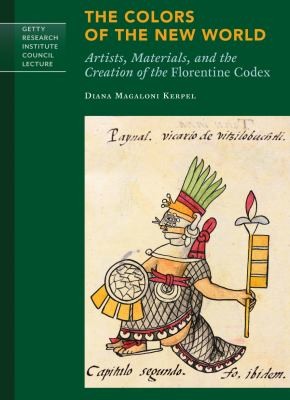
The Colors of the New World: Artists' Materials and the Creation of the Florentine Codex
0
0
As an Amazon Associate and affiliate partner, Menrva Books earns from qualifying purchases. Learn more
Author Description
In August 1576, in the midst of an outbreak of the plague, the Spanish Franciscan friar Bernardino de Sahagún and twenty-two indigenous artists locked themselves inside the school of Santa Cruz de Tlaltelolco in Mexico City with a mission: to create nothing less than the first illustrated encyclopedia of the New World. Today this twelve-volume manuscript is preserved in the Biblioteca Medicea Laurenziana in Florence and is widely known as the Florentine Codex. A monumental achievement, the Florentine Codex is the single most important artistic and historical document for studying the peoples and cultures of pre-Hispanic and colonial Central Mexico. It reflects both indigenous and Spanish traditions of writing and painting, including parallel columns of text in Spanish and Nahuatl and more than two thousand watercolor illustrations prepared in European and Aztec pictorial styles. This volume reveals the complex meanings inherent in the selection of the pigments used in the manuscript, offering a fascinating look into a previously hidden symbolic language. Drawing on cuttingedge approaches in art history, anthropology, and the material sciences, the book sheds new light on one of the world’s great manuscripts—and on a pivotal moment in the early modern Americas.
Menrva's Summary
THE THESIS
This book investigates the symbolic language embedded within the pigments used in the Florentine Codex, a monumental illustrated encyclopedia of the New World created by Spanish friar Bernardino de Sahagún and indigenous artists. The Florentine Codex, a twelve-volume manuscript, stands as a critical document for understanding pre-Hispanic and colonial Central Mexico, blending indigenous and Spanish artistic and literary traditions. This volume, by Diana Magaloni, utilizes art history, anthropology, and material sciences to decode the complex meanings associated with the selection and application of pigments, offering new insights into this pivotal early modern American manuscript.
THE SCOPE MAP
- Analysis of the specific pigments and their symbolic meanings within the Florentine Codex.
- Exploration of the collaboration between Bernardino de Sahagún and twenty-two indigenous artists.
- Examination of the manuscript's creation within the context of the 1576 plague outbreak.
- Discussion of the dual European and Aztec pictorial styles present in over two thousand watercolor illustrations.
- Insights into the intersection of indigenous and Spanish traditions in writing and painting.
- Application of cutting-edge approaches from art history, anthropology, and material sciences.
- A focus on the Biblioteca Medicea Laurenziana's preserved twelve-volume manuscript, known as the Florentine Codex.
THE AUTHORITY PERSPECTIVE
The book is recognized for its interdisciplinary approach, drawing on art history, anthropology, and material sciences to illuminate the symbolic significance of pigments in the Florentine Codex. It offers a deep dive into one of the most important artistic and historical documents for studying pre-Hispanic and colonial Central Mexico. The work is praised for shedding new light on the complex meanings embedded in the manuscript's illustrations and the collaborative creation process. This volume is considered a significant contribution to the study of early modern Americas and indigenous artistic traditions.
Page Count:
80
Publication Date:
2014-01-01
ISBN-10:
1606063294
ISBN-13:
9781606063293
Art
Non-Fiction
History
Art History
Indigenous Art
Colonial History
Community Tags
Similar Books














