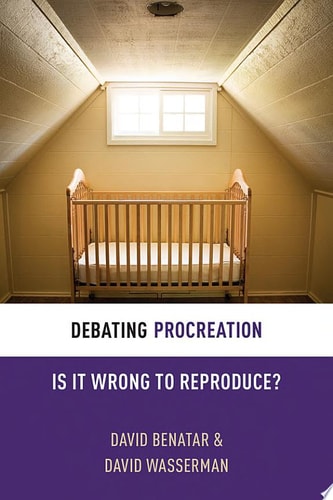
Debating Procreation: Is it Wrong to Reproduce
0
0
As an Amazon Associate and affiliate partner, Menrva Books earns from qualifying purchases. Learn more
Author Description
While procreation is ubiquitous, attention to the ethical issues involved in creating children is relatively rare. In Debating Procreation, David Benatar and David Wasserman take opposing views on this important question. David Benatar argues for the anti-natalist view that it is always wrong to bring new people into existence. He argues that coming into existence is always a serious harm and that even if it were not always so, the risk of serious harm is sufficiently great to make procreation wrong. In addition to these "philanthropic" arguments, he advances the "misanthropic" one that because humans are so defective and cause vast amounts of harm, it is wrong to create more of them.David Wasserman defends procreation against the anti-natalist challenge. He outlines a variety of moderate pro-natalist positions, which all see procreation as often permissible but never required. After criticizing the main anti-natalist arguments, he reviews those pronatalist positions. He argues that constraints on procreation are best understood in terms of the role morality of prospective parents, considers different views of that role morality, and argues for one that imposes only limited constraints based on the well-being of the future child. He then argues that the expected good of a future child and of the parent-child relationship can provide a strong justification for procreation in the face of expected adversities without giving individuals any moral reason to procreate
Menrva's Summary
THE THESIS
This book investigates the moral permissibility of human reproduction by contrasting anti-natalist and pro-natalist ethical frameworks. David Benatar, a prominent philosopher known for his work on anti-natalism, and David Wasserman, an expert in bioethics and parental responsibility, engage in a structured debate. The authors utilize philosophical argumentation and normative ethics to evaluate whether the act of bringing new life into existence is inherently harmful or morally justifiable.
THE SCOPE MAP
What You Will Find
- Philosophical arguments regarding the harm of existence versus the potential for well-being.
- Analysis of anti-natalist perspectives, including philanthropic and misanthropic justifications.
- Examination of moderate pro-natalist positions and the role morality of prospective parents.
- Ethical frameworks concerning the constraints on reproduction based on the future child's welfare.
THE AUTHORITY PERSPECTIVE
Experts recognize this work as a significant contribution to the field of applied ethics, providing a balanced platform for two divergent philosophical viewpoints. Readers frequently note the intellectual rigor of the arguments, which makes the text suitable for both academic study and those interested in the ethics of procreation.
Page Count:
278
Publication Date:
2015-06-01
Publisher:
Oxford University Press
ISBN-10:
0199333548
ISBN-13:
9780199333547
Philosophy
Non-Fiction
Life
Parenting
Social Philosophy
Human Reproduction
Ethics
Community Tags
Similar Books