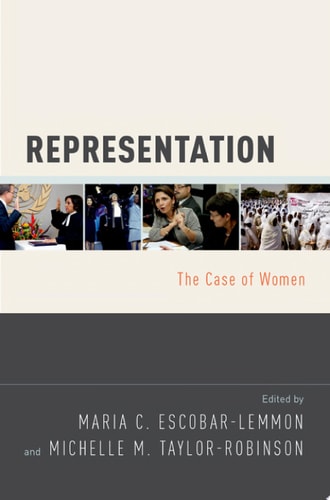
Representation: The Case of Women
0
0
As an Amazon Associate and affiliate partner, Menrva Books earns from qualifying purchases. Learn more
Author Description
While there is a vast literature on women's political interests, there is hardly any consensus about what constitutes "women's interests" or how scholars should approach studying them. Representation can occur in various venues or by various actors, but, due to power imbalances across political groups, it is not always realized in any substantive way.The essays in this book constitute a broad and geographically comparative move toward defining new and unified theoretical orientations to studying representation among women. Representation involves not only getting group members into government, but also articulating group interests and translating those interests into policy. Because competing groups have different policy preferences and act out of self-interest, representation of historically marginalized groups is a contentious, contingent process that is likely to ebb and flow. The book begins with a theoretical positioning of the meaning of women's interests, issues and preferences. It considers the need to add nuance to how we conceive of and study intersectionality and the dangers of stretching the meaning of substantive representation. It then looks at descriptive representation in political parties, high courts, and legislatures, as well as how definitions of "interest" affect who represents women in legislatures and social movements. The book concludes by suggesting testable propositions and avenues for future research to enhance understanding about representation of women and of other historically under-represented groups. Chapters include cases from the United States, Latin America, Western Europe and Africa.
Menrva's Summary
THE THESIS
This book investigates the conceptual and practical challenges of defining and achieving substantive political representation for women within diverse global governance structures. Authors Maria C. Escobar-Lemmon and Michelle M. Taylor-Robinson synthesize existing political science literature to address the lack of consensus regarding what constitutes women's interests. They argue that representation is a contentious, contingent process influenced by power imbalances and competing group preferences, necessitating a more nuanced approach to intersectionality and policy translation.
THE SCOPE MAP
What You Will Find
- Comparative analysis of political representation across the United States, Latin America, Western Europe, and Africa.
- Theoretical frameworks for evaluating descriptive versus substantive representation in legislatures, high courts, and political parties.
- Methodological critiques regarding the conceptualization of intersectionality and the risks of over-extending definitions of representation.
- Testable propositions and research agendas designed to advance the study of historically marginalized groups in government.
THE AUTHORITY PERSPECTIVE
Scholars and students of political science identify this work as a significant contribution to the comparative study of gender and politics. Readers frequently note the academic density of the prose and the utility of the book's structured approach to defining complex political phenomena.
Page Count:
304
Publication Date:
2014-06-11
Publisher:
Oxford University Press
ISBN-10:
0199340110
ISBN-13:
9780199340118
Sociology
Gender Studies
Political Activity
Public Policy
Representative government and representation
Comparative Politics
Womens rights
Feminist Theory
Woman Studies
Women
Community Tags
Similar Books