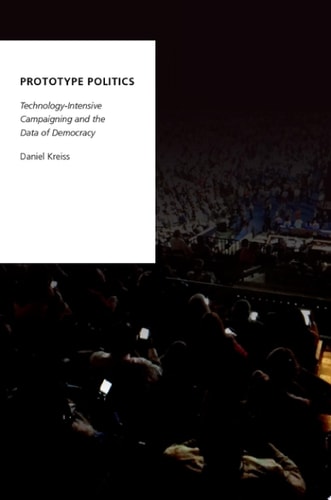
Prototype Politics
0
0
As an Amazon Associate and affiliate partner, Menrva Books earns from qualifying purchases. Learn more
Author Description
Given the advanced state of digital technology and social media, one would think that the Democratic and Republican Parties would be reasonably well-matched in terms of their technology uptake and sophistication. But as past presidential campaigns have shown, this is not the case. So what explains this odd disparity? Political scientists have shown that Republicans effectively used the strategy of party building and networking to gain campaign and electoral advantage throughout the twentieth century. In Prototype Politics, Daniel Kreiss argues that contemporary campaigning has entered a new technology-intensive era that the Democratic Party has engaged to not only gain traction against the Republicans, but to shape the new electoral context and define what electoral participation means in the twenty-first century. Prototype Politics provides an analytical framework for understanding why and how campaigns are newly technology-intensive, and why digital media, data, and analytics are at the forefront of contemporary electoral dynamics. The book discusses the importance of infrastructure, the contexts within which technological innovation happens, and how the collective making of prototypes shapes parties and their technological futures. Drawing on an analysis of the careers of 629 presidential campaign staffers from 2004-2012, as well as interviews with party elites on both sides of the aisle, Prototype Politics details how and why the Democrats invested more in technology, were able to attract staffers with specialized expertise to work in electoral politics, and founded an array of firms to diffuse technological innovations down ballot and across election cycles. Taken together, this book shows how the differences between the major party campaigns on display in 2012 were shaped by their institutional histories since 2004, as well as that of their extended network of allied organizations. In the process, this book argues that scholars need to understand how technology is developed and deployed within political organizations.
Menrva's Summary
THE THESIS
This book investigates the disparity in technological adoption between the Democratic and Republican parties and how this divergence shapes modern electoral outcomes. Daniel Kreiss, a scholar of political communication and technology, utilizes an institutional framework to analyze how campaign infrastructure and professional networks influence the development of digital strategies. By examining the shift toward technology-intensive campaigning, the author argues that the Democratic Party's investment in specialized expertise and firm creation has fundamentally altered the landscape of twenty-first-century political participation.
THE SCOPE MAP
What You Will Find
- Analysis of 629 presidential campaign staffer careers from 2004 to 2012.
- A framework for understanding the role of digital media, data, and analytics in electoral dynamics.
- Primary source interviews with party elites and campaign strategists.
- Examination of how institutional histories and allied organizations influence technological innovation.
THE AUTHORITY PERSPECTIVE
Experts in political science and media studies recognize this work as a significant contribution to the study of campaign infrastructure and digital strategy. Readers frequently note the academic rigor of the research and the clarity with which the author connects historical party development to contemporary technological practices.
Page Count:
272
Publication Date:
2016-01-01
Publisher:
Oxford University Press
ISBN-10:
0199350264
ISBN-13:
9780199350261
Technology
Elections
American Politics
Sociology
Community Tags
Similar Books