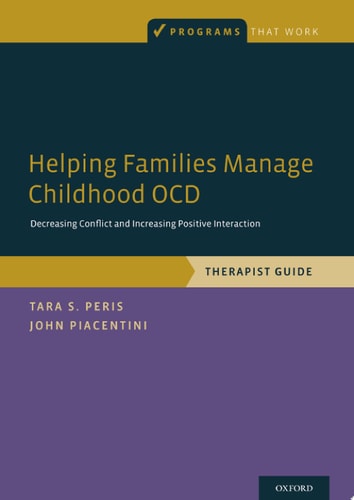
Helping Families Manage Childhood OCD: Decreasing Conflict and Increasing Positive Interaction, Therapist Guide
0
0
As an Amazon Associate and affiliate partner, Menrva Books earns from qualifying purchases. Learn more
Author Description
Pediatric obsessive compulsive disorder (OCD) is a common condition that can take a substantial toll on the entire family system. Research suggests that families of youth with OCD face a unique set of difficulties in that they often are intimately involved in the child's symptoms. This involvement, also known as symptom accommodation, can be quite taxing, and it is often accompanied by high levels of distress, anxiety, and family conflict. These family responses, while natural and understandable, pose very real problems for treatment. Growing research suggests that poor family functioning undermines successful child OCD treatment.Helping Families Manage Childhood OCD provides clinicians with a comprehensive set of strategies for identifying and intervening with family dynamics that are likely to interfere with successful treatment of pediatric OCD. Moving beyond commonly employed techniques such as parent education and behavior management training, this manual includes skills training in emotion regulation for the entire family. It offers step-by-step strategies for helping family members to identify and manage their own emotional responses to OCD and provides a foundation for more effective and collaborative problem-solving around OCD. Through interactive exercises, families develop strategies for communicating around and troubleshooting difficult OCD episodes as well as strategies for promoting a more positive home environment in which to work on OCD.
Menrva's Summary
THE THESIS
This guide investigates how clinicians can mitigate the negative impact of symptom accommodation in families of children with obsessive-compulsive disorder to improve treatment outcomes. Authors John C. Piacentini and Tara S. Peris, both established experts in pediatric mental health, argue that family dynamics are central to the success of OCD interventions. They present a structured framework that moves beyond traditional parent education to incorporate emotion regulation and collaborative problem-solving techniques for the entire family unit.
THE SCOPE MAP
What You Will Find
- Clinical strategies for identifying and reducing symptom accommodation behaviors.
- Step-by-step protocols for family-wide emotion regulation training.
- Interactive exercises designed to improve communication during OCD episodes.
- Methodologies for fostering a positive home environment to support therapeutic progress.
THE AUTHORITY PERSPECTIVE
Clinicians and mental health professionals frequently cite this manual as a foundational resource for integrating family systems theory into pediatric OCD treatment. Experts highlight the text for its practical, session-by-session structure and its focus on actionable skills rather than purely theoretical concepts.
Page Count:
140
Publication Date:
2016-08-11
Publisher:
Oxford University Press
ISBN-10:
0199357609
ISBN-13:
9780199357604
Psychology
Mental Health
Parent and child
Parenting
Family Therapy
Community Tags
Similar Books