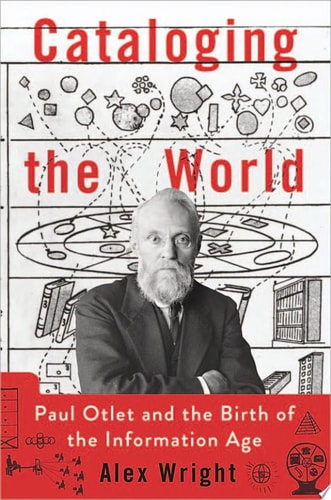
Cataloging the World: Paul Otlet and the Birth of the Information Age
0
0
As an Amazon Associate and affiliate partner, Menrva Books earns from qualifying purchases. Learn more
Author Description
The dream of capturing and organizing knowledge is as old as history. From the archives of ancient Sumeria and the Library of Alexandria to the Library of Congress and Wikipedia, humanity has wrestled with the problem of harnessing its intellectual output. The timeless quest for wisdom has been as much about information storage and retrieval as creative genius.In Cataloging the World, Alex Wright introduces us to a figure who stands out in the long line of thinkers and idealists who devoted themselves to the task. Beginning in the late nineteenth century, Paul Otlet, a librarian by training, worked at expanding the potential of the catalog card, the world's first information chip. From there followed universal libraries and museums, connecting his native Belgium to the world by means of a vast intellectual enterprise that attempted to organize and code everything ever published. Forty years before the first personal computer and fifty years before the first browser, Otlet envisioned a network of "electric telescopes" that would allow people everywhere to search through books, newspapers, photographs, and recordings, all linked together in what he termed, in 1934, a réseau mondial--essentially, a worldwide web.Otlet's life achievement was the construction of the Mundaneum--a mechanical collective brain that would house and disseminate everything ever committed to paper. Filled with analog machines such as telegraphs and sorters, the Mundaneum--what some have called a "Steampunk version of hypertext"--was the embodiment of Otlet's ambitions. It was also short-lived. By the time the Nazis, who were pilfering libraries across Europe to collect information they thought useful, carted away Otlet's collection in 1940, the dream had ended. Broken, Otlet died in 1944.Wright's engaging intellectual history gives Otlet his due, restoring him to his proper place in the long continuum of visionaries and pioneers who have struggled to classify knowledge, from H.G. Wells and Melvil Dewey to the architects of the modern web.
Menrva's Summary
THE THESIS
This book investigates the life and intellectual contributions of Paul Otlet, a Belgian visionary who anticipated the modern information age through his efforts to organize the sum of human knowledge. Alex Wright, an expert in information architecture, examines Otlet’s development of the Universal Decimal Classification system and his ambitious construction of the Mundaneum. The narrative situates Otlet within the broader historical continuum of knowledge management, arguing that his analog experiments served as a direct precursor to the contemporary internet and digital information retrieval systems.
THE SCOPE MAP
What You Will Find
- A detailed history of the Mundaneum and its role as a proto-digital information hub.
- Analysis of the Universal Decimal Classification system as a foundational information architecture tool.
- Historical context regarding the evolution of library science and global knowledge networks from the late 19th century to the mid-20th century.
- Examination of the impact of geopolitical instability, specifically the Nazi occupation of Belgium, on the preservation of intellectual archives.
THE AUTHORITY PERSPECTIVE
Experts and historians of technology recognize this work as a vital recovery of a neglected pioneer in information science. Readers frequently note the accessibility of the prose, which effectively bridges the gap between technical history and biographical narrative for a general audience.
Page Count:
361
Publication Date:
2014-01-01
Publisher:
Oxford University Press
ISBN-10:
0199354200
ISBN-13:
9780199354207
Non-Fiction
History
Biography
Classification books
Information Science
World Wide Web
Technology
European History
Bibliographers biography
English & College Success
Technology & Engineering
Trades & Technology
Documentation
Modern History
English
Biography Autobiography
Community Tags
Similar Books