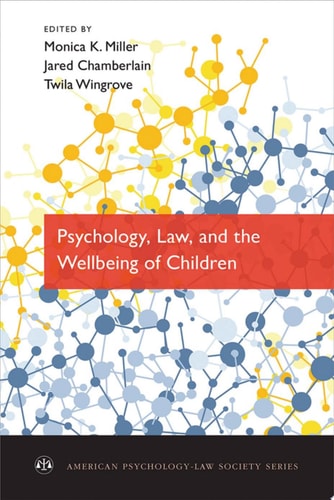
Psychology, Law, and the Wellbeing of Children
0
0
As an Amazon Associate and affiliate partner, Menrva Books earns from qualifying purchases. Learn more
Author Description
Lawmakers and judges often enact and enforce laws and policies that impact youth. The extent to which these legal actions are sensitive to juveniles' perspectives and experiences has changed recently. Compared to an earlier time when juvenlies were treated the same as adults, many policies are now created with the needs of juveniles in mind, thanks in part to psychological studies that have revealed that the decision making, behavior, and cognitions of children vary drastically from those of adults.Unique in its angle and in the breadth of social issues it covers, Psychology, Law, and the Wellbeing of Children brings together new research and analyses to address how legal actions affect children's wellbeing. It addresses how civil and criminal law has evolved to protect, and sometimes inadvertently neglect or harm, the wellbeing and development of children. Each chapter describes a law or policy affecting children, identifies the relevant psychological issues, reviews the research that has been conducted or should be conducted, and provides recommendations for professionals in law and/or psychology. With contributions from top researchers and practitioners in the field, chapters discuss many current debates, including issues such as gender-specific programming for juvenile delinquents, interrogations of juveniles, changes in divorce and custody procedures, programs for imprisoned mothers, and legal actions adopted to protect the health of children and society (e.g., HPV vaccinations, considering child obesity to be abuse). This book will be a vital resource for those interested in protecting the wellbeing of children, including academics and researchers in psychology, criminology, and sociology; practitioners such as judges, attorneys, forensic psychologists, psychiatrists, and social workers; and graduate and law students.
Menrva's Summary
THE THESIS
This book investigates the intersection of psychological research and legal policy to determine how current legislative and judicial frameworks impact the developmental wellbeing of children. The authors, Jared Chamberlain, Monica K. Miller, and Twila Wingrove, synthesize contributions from leading researchers and practitioners to evaluate the efficacy of laws governing juvenile experiences. By contrasting historical treatment of youth with modern, psychology-informed policies, the text provides a framework for assessing how civil and criminal systems can better protect or inadvertently harm minors. The work serves as a bridge between empirical psychological data and the practical application of law in various social contexts.
THE SCOPE MAP
What You Will Find
- Analysis of legal evolution regarding juvenile rights and protections in civil and criminal courts.
- Examination of specific policy areas including juvenile interrogation, custody procedures, and gender-specific delinquency programming.
- Review of current research methodologies used to assess the impact of legal actions on child development.
- Recommendations for interdisciplinary collaboration between legal professionals and psychological practitioners.
THE AUTHORITY PERSPECTIVE
Experts identify this volume as a comprehensive reference for professionals navigating the intersection of forensic psychology and juvenile law. Readers frequently note the academic density of the prose, which makes it a suitable resource for graduate students and practitioners seeking evidence-based insights into child-centric policy.
Page Count:
298
Publication Date:
2013-01-01
Publisher:
Oxford University Press
ISBN-10:
0199356890
ISBN-13:
9780199356898
Psychology
Criminology
Sociology
Professional Career & Trade
Law
Community Tags
Similar Books