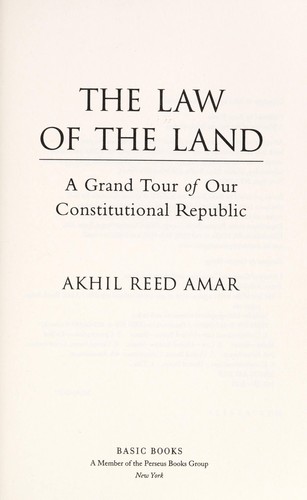
The Law of the Land
0
0
As an Amazon Associate and affiliate partner, Menrva Books earns from qualifying purchases. Learn more
Author Description
From Illinois to Alabama, and from Florida to Utah, our laws and legal debates arise from distinctive local settings within our vast and varied nation. As the renowned scholar Akhil Amar explains, Abraham Lincoln's argument against the legality of succession can be traced to his Midwestern upbringing, just as a close look at the Florida legislature and state Supreme Court reveals the fundamental wrongness of the Bush v. Gore decision. Amar profiles Alabama's Hugo Black, the dominant constitutional jurist of the twentieth century, and California's Anthony Kennedy, the powerful swing justice on the current Court. He probes Brown v. Board of Education, and explores the divisiveness of the Second and Fourth Amendments. An expert guide to America's constitutional landscape, Amar sheds new light on American history and politics and shows how America's legal tradition unites a vast and disparate land. In The Law of the Land, renowned legal scholar Akhil Reed Amar explores the most pressing questions in American jurisprudence through a close look at how our nation's geography has shaped its laws. Writing about Illinois, Amar discusses Lincoln's arguments against the legality of secession in the context of his upbringing on what was then the country's western frontier. Writing about New Jersey, he examines the career of Lord Camden, a British defender of the individual's rights against government intrusion, and the legacy of Camden's beliefs in that state's laws. Writing about Florida, Amar shows how a close look at the workings of the state legislature and state supreme court reveals the fundamental wrongness of the Bush v. Gore decision. His essay about gun-loving Utah, meanwhile, is a subtle examination of the second amendment that will infuriate both sides in the debate. Other states covered within include Iowa, Ohio, Massachusetts, Alabama, California, Kansas, and New York
Menrva's Summary
THE THESIS
The Law of the Land investigates how the diverse geography and regional histories of the United States have profoundly shaped its laws and legal debates. Renowned legal scholar Akhil Reed Amar examines pivotal moments and figures, arguing that understanding a state's unique context is crucial to comprehending its legal traditions and landmark decisions. Through case studies spanning from Abraham Lincoln's arguments against secession rooted in his Midwestern upbringing to the intricacies of the Bush v. Gore decision influenced by Florida's state courts, Amar demonstrates the deep connection between place and jurisprudence. He profiles influential figures like Hugo Black and Anthony Kennedy, and analyzes contentious issues such as the Second and Fourth Amendments, revealing how America's legal framework unites a vast and disparate nation.
THE SCOPE MAP
- Analysis of Abraham Lincoln's arguments against secession, linked to his Midwestern origins.
- Examination of the Bush v. Gore decision through the lens of Florida's state legislature and Supreme Court.
- Profiles of key legal figures such as Alabama's Hugo Black and California's Anthony Kennedy.
- Exploration of the divisiveness surrounding the Second and Fourth Amendments.
- Discussion of the historical context of constitutional law in various states, including Illinois, Florida, Utah, New Jersey, Iowa, Ohio, Massachusetts, Alabama, California, Kansas, and New York.
- Investigation into the legacy of British jurist Lord Camden's influence on New Jersey's laws.
- A nuanced examination of the Second Amendment, particularly in relation to Utah's culture.
THE AUTHORITY PERSPECTIVE
Akhil Reed Amar's "The Law of the Land" is recognized as a significant contribution to the study of American constitutional law and history, offering a unique geographical perspective. Scholars and readers alike have noted Amar's ability to connect seemingly disparate legal issues and historical events to their specific regional origins, providing fresh insights into well-known cases and amendments. The book is praised for its detailed analysis and its capacity to illuminate the complex relationship between place and law across the United States. Its approach is seen as particularly effective in demonstrating how local contexts have shaped national legal discourse and practice.
Page Count:
357
Publication Date:
2015-01-01
ISBN-10:
0465065902
ISBN-13:
9780465065905
Politics
History
Non-Fiction
American History
Law
Constitutional Law
Community Tags
Similar Books














