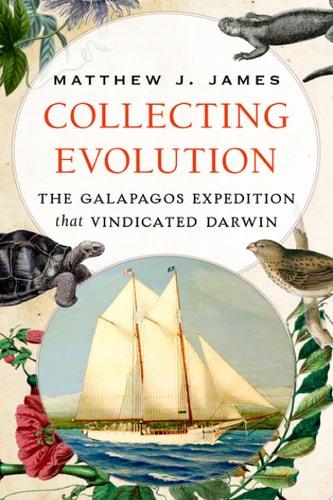
Collecting Evolution: The Galapagos Expedition that Vindicated Darwin
0
0
As an Amazon Associate and affiliate partner, Menrva Books earns from qualifying purchases. Learn more
Author Description
In 1905, eight men from the California Academy of Sciences set sail from San Francisco for a scientific collection expedition in the Galapagos Islands, and by the time they were finished in 1906, they had completed one of the most important expeditions in the history of both evolutionary and conservation science. These scientists collected over 78,000 specimens during their time on the islands, validating the work of Charles Darwin and laying the groundwork for foundational evolution texts like Darwin's Finches. Despite its significance, almost nothing has been written on this voyage, lost amongst discussion of Darwin's trip on the Beagle and the writing of David Lack.In Collecting Evolution, author Matthew James finally tells the story of the 1905 Galapagos expedition. James follows these eight young men aboard the Academy to the Galapagos and back, and reveals the reasons behind the groundbreaking success they had. A current Fellow of the California Academy of Sciences, James uses his access to unpublished writings and photographs to provide unprecedented insight into the expedition. We learn the voyagers' personal stories, and how, for all the scientific progress that was made, just as much intense personal drama unfolded on the trip. This book shares a watershed moment in scientific history, crossed with a maritime adventure. There are four tangential suicides and controversies over credit and fame. Collecting Evolution also explores the personal lives and scientific context that preceded this voyage, including what brought Darwin to the Galapagos on the Beagle voyage seventy years earlier. James discusses how these men thought of themselves as "collectors" before they thought of themselves as scientists, and the implications this had on their approach and their results.In the end, the voyage of the Academy proved to be crucial in the development of evolutionary science as we know it. It is the longest expedition in Galapagos history, and played a critical role
Menrva's Summary
THE THESIS
How did the 1905 California Academy of Sciences expedition to the Galapagos Islands provide the empirical evidence necessary to validate Darwinian evolutionary theory? Matthew J. James, a Fellow of the California Academy of Sciences, utilizes previously unpublished journals, correspondence, and photographs to reconstruct the logistical and scientific efforts of the eight-man crew. The author argues that this specific voyage, often overshadowed by Darwin's own earlier observations, served as a critical turning point in the professionalization of evolutionary biology and conservation science.
THE SCOPE MAP
What You Will Find
- Detailed analysis of the 1905-1906 California Academy of Sciences expedition logistics and specimen collection methods.
- Historical context regarding the transition from Victorian-era "collecting" to modern scientific research practices.
- Primary source documentation including personal diaries, unpublished photographs, and internal correspondence of the expedition members.
- Examination of the interpersonal conflicts, including professional rivalries and personal tragedies that occurred during the voyage.
THE AUTHORITY PERSPECTIVE
Experts recognize this work as a significant contribution to the history of science, specifically for its focus on an under-documented expedition. Readers frequently note the balance between technical scientific history and the narrative account of the expedition's internal personal dramas.
Page Count:
284
Publication Date:
2017-01-01
Publisher:
Oxford University Press
ISBN-10:
0199354626
ISBN-13:
9780199354627
History
Science
Biography
Natural History
Life sciences
Exploration
Earth Sciences
Evolution
Taxonomy
Evolution history
Community Tags
Other Editions(2)
Similar Books









Reader Comments
Share Your Thoughts
No comments yet. Be the first to share your thoughts!