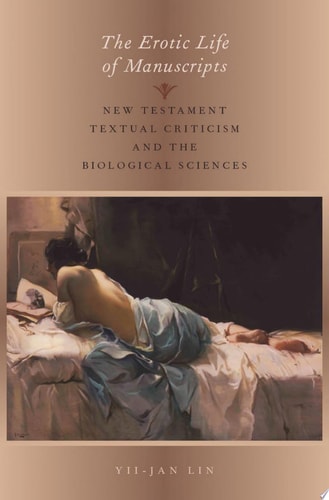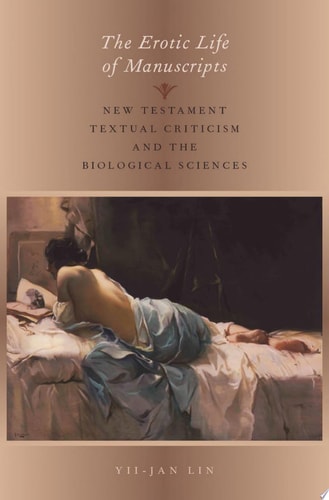
The Erotic Life of Manuscripts: New Testament Textual Criticism and the Biological Sciences
0
0
As an Amazon Associate and affiliate partner, Menrva Books earns from qualifying purchases. Learn more
Author Description
Since the New Testament's inception as written text, its manuscripts have been subject to all the dangers of history: scribal error, emendation, injury, and total destruction. The traditional goal of modern textual criticism has been to reconstruct an "original text" from surviving manuscripts, adjudicating among all the variant texts resulting from the slips, additions, and embellishments of scribal hand-copying. Because of the way manuscripts circulate and give rise to new copies, it can be said that they have an "erotic" life: they mate and breed, bear offspring, and generate families and descendants. New Testament textual critics of the eighteenth century who began to use this language to group texts into families and genealogies were not pioneering new approaches, but rather borrowing the metaphors and methods of natural scientists. Texts began to be classified into "families, tribes, and nations," and later were racialized as "African" or "Asian," with distinguishable "textual physiognomies" and "textual complexions." The Erotic Life of Manuscripts explores this curious relationship between the field of New Testament textual criticism and the biological sciences, beginning with the eighteenth century and extending into the present.While these biological metaphors have been powerful tools for textual critics, they also produce problematic understandings of textual "purity" and agency, with the use of scientific discourse artificially separating the work of textual criticism from literary interpretation. Yii-Jan Lin shows how the use of biological classification, genealogy, evolutionary theory, and phylogenetics has shaped-and limited-the goals of New Testament textual criticism, the greatest of which is the establishment of an authoritative, original text. She concludes by proposing new metaphors for the field.
Menrva's Summary
THE THESIS
How have biological metaphors and scientific classification methods historically shaped the goals and limitations of New Testament textual criticism? Yii-Jan Lin, a scholar of New Testament and early Christian literature, investigates the intersection of philology and the natural sciences. She argues that the adoption of genealogical and evolutionary frameworks—originally intended to organize manuscript families—has inadvertently introduced problematic concepts of racialization and textual purity into the field. By examining the history of these metaphors, Lin demonstrates how scientific discourse has constrained the interpretive possibilities of biblical scholarship.
THE SCOPE MAP
What You Will Find
- Historical analysis of eighteenth-century textual criticism and its reliance on natural history metaphors.
- Examination of how manuscripts are categorized into families, tribes, and nations.
- Critique of the application of evolutionary theory and phylogenetics to textual transmission.
- Proposals for alternative metaphors to replace biological models in biblical studies.
Scope Limits
- The book does not provide a comprehensive history of the New Testament text itself.
- It does not offer a technical manual for performing modern textual criticism.
THE AUTHORITY PERSPECTIVE
Scholars in the field of biblical studies recognize this work as a significant contribution to the history of the discipline and its methodological assumptions. Readers frequently note the academic density of the prose, which requires a foundational understanding of both textual criticism and the history of biological science.
Page Count:
219
Publication Date:
2016-01-01
Publisher:
Oxford University Press
ISBN-10:
0190493682
ISBN-13:
9780190493684
History
Religion
Science History
Earth Sciences
Philosophy of
Evolution
Bibles
Academic
Community Tags
Similar Books