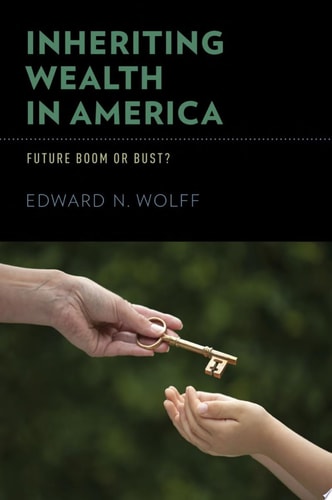
Inheriting Wealth in America: Future Boom or Bust?
0
0
As an Amazon Associate and affiliate partner, Menrva Books earns from qualifying purchases. Learn more
Author Description
Inheritances are often regarded as a societal "evil," enabling great fortunes to be passed from one generation to another, thus exacerbating wealth inequality and reducing wealth mobility. Discussions of inheritances in America bring to mind the Vanderbilts, Rockefellers, and "trust fund babies"---people who receive enough money through inheritances or gifts that they do not have any need to work during their lifetime. Though these are, of course, extreme outliers, inheritances in America have a reputation for being a way the rich keep getting richer. In Inheriting Wealth in America, Edward Wolff seeks to counter these misconceptions with data and arguments that illuminate who inherits what in the United States and what results from these wealth transfers.Using data from the Survey of Consumer Finances---a triennial survey conducted by the Federal Reserve Board that contains detailed information on household wealth, inheritances, and gifts---as well as the Panel Study of Income Dynamics and a simulation model over years 1989 to 2010, Wolff reports six major findings on the state of inheritances in America. First, wealth transfers (inheritances and gifts) accounted for less than one quarter of household wealth. However, for persons age 75 and over, the figure was about two-fifths since they have more time to receive wealth transfers. Indirect evidence, derived from the simulation model, indicates a figure closer to two-thirds at end of life - probably the best estimate. Second, despite prognostications of a coming "inheritance boom," it has not materialized yet. Only a small (and statistically insignificant) uptick in average wealth transfers was observed over the period, and wealth transfers were actually down as a share of household wealth. Third, while wealth transfers are greater in dollar amount for richer households than poorer ones, they constitute a smaller share of the accumulated wealth of the rich. Fourth, contrary to popular belief, inheritances and gifts
Menrva's Summary
THE THESIS
Does the anticipated inheritance boom in the United States represent a significant driver of wealth inequality or a misunderstood economic phenomenon? Edward N. Wolff, a professor of economics and expert on wealth distribution, utilizes longitudinal data to challenge common assumptions regarding intergenerational wealth transfers. By analyzing the Survey of Consumer Finances and the Panel Study of Income Dynamics, the author constructs a rigorous framework to evaluate the actual impact of inheritances and gifts on household net worth between 1989 and 2010.
THE SCOPE MAP
What You Will Find
- Longitudinal analysis of wealth transfers using the Survey of Consumer Finances and the Panel Study of Income Dynamics.
- A simulation model estimating the lifetime impact of inheritances on household wealth accumulation.
- Comparative data on wealth transfers across different socioeconomic strata and age demographics.
- Empirical evidence addressing the prevalence and growth of intergenerational wealth transfers in the American economy.
THE AUTHORITY PERSPECTIVE
Experts recognize this work as a critical, data-driven intervention in the public discourse surrounding wealth mobility and inequality. Readers frequently note the academic density of the prose, which provides a necessary corrective to popular misconceptions through meticulous statistical analysis.
Page Count:
266
Publication Date:
2015-01-01
Publisher:
Oxford University Press
ISBN-10:
0199353972
ISBN-13:
9780199353972
Economics
Wealth
Sociology
Public Policy
Inheritance And Succession
Finance
Wealth Inequality
Community Tags
Other Editions(2)
Similar Books







Reader Comments
Share Your Thoughts
No comments yet. Be the first to share your thoughts!