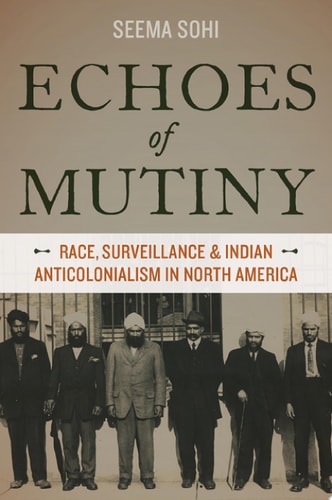
Echoes of Mutiny: Race, Surveillance, and Indian Anticolonialism in North America
0
0
As an Amazon Associate and affiliate partner, Menrva Books earns from qualifying purchases. Learn more
Author Description
How did thousands of Indians who migrated to the Pacific Coast of North America during the early twentieth century come to forge an anticolonial movement that British authorities claimed nearly toppled their rule in India during the First World War? Seema Sohi traces how Indian labor migrants, students, and intellectual activists who journeyed across the globe seeking to escape the exploitative and politically repressive policies of the British Raj, linked restrictive immigration policies and political repression in North America to colonial subjugation at home. In the process, they developed an international anticolonial consciousness that boldly confronted the British and American empires. Hoping to become an important symbol for those battling against racial oppression and colonial subjugation across the world, Indian anticolonialists also provoked a global inter-imperial collaboration between U.S. and British officials to repress anticolonial revolt. They symbolized the hope of the world's racialized subjects and the fears of those who worried about the global disorder they could portend. Echoes of Mutiny provides an in-depth and transnational look at the deeply intertwined relationship between anti-Asian racism, Indian anticolonialism, and state antiradicalism in early twentieth century U.S. and global history. Through extensive archival research, Sohi uncovers the dialectical relationship between the rise of Indian anticolonialism and state repression in North America and demonstrates how Indian anticolonialists served as catalysts for the implementation of restrictive U.S. immigration and antiradical laws as well as the expansion of state power in early twentieth century India and America. Indian migrants came to understand their struggles against racial exclusion and political repression in North America as part of a broader movement against white supremacy and colonialism and articulated radical visions of anticolonialism that called not only for the end of
Menrva's Summary
THE THESIS
This work investigates how Indian migrants in early twentieth-century North America synthesized their experiences of racial exclusion with a broader anticolonial movement against the British Raj. Seema Sohi, an associate professor of ethnic studies, utilizes extensive archival research to examine the transnational connections between labor migration, state surveillance, and the rise of radical political consciousness. The book argues that the collaboration between U.S. and British authorities to suppress these activists significantly influenced the development of restrictive immigration policies and the expansion of state power in both nations.
THE SCOPE MAP
What You Will Find
- Analysis of the Ghadar movement and its impact on Indian anticolonialism.
- Examination of the inter-imperial collaboration between U.S. and British intelligence agencies.
- Historical documentation of early twentieth-century anti-Asian immigration laws and antiradical legislation.
- A transnational framework connecting domestic racial politics in North America to global colonial subjugation.
THE AUTHORITY PERSPECTIVE
Scholars and historians recognize this text as a significant contribution to the study of transnational political movements and the history of state surveillance. Readers frequently note the academic rigor and the depth of archival evidence provided to support the author's arguments regarding the intersection of race and empire.
Page Count:
288
Publication Date:
2014-09-01
Publisher:
Oxford University Press
ISBN-10:
0199376255
ISBN-13:
9780199376254
History
Immigration
United States
Immigrants
Great Britain
Asian History
Racism
Colonialism
Sociology
American History
North America
Community Tags
Similar Books